Most "HDB loan vs bank loan" comparisons show you today's rates and stop there. That tells you nothing about what actually happens to your interest bill over a 25-year mortgage, because rates move — a lot, sometimes violently. This runs one buyer through three real strategies, against actual Singapore interest rate history going back to the 1997-98 Asian Financial Crisis, to see what each one actually costs.
Not advice — a simulation, built to be checked, not believed on faith.
The scenario
A single buyer, age 35, buys an S$800,000 HDB resale flat on 1 August 2026. No CPF anywhere in this article — every number below is a pure cash view of interest and principal, so the figures aren't muddied by CPF Ordinary Account mechanics. That's a real simplification, stated once, here.
Loan amount: S$600,000 for both loan types (75% of S$800,000 — HDB and bank loans have shared the same LTV cap since 20 August 2024).1
Tenure: 25 years for both loan types — not 30. This is worth stating plainly because it isn't obvious: an HDB concessionary loan is capped at 25 years, full stop, and separately capped at "tenure plus the youngest borrower's age can't exceed 65" — for a 35-year-old, 25 years lands at age 60, so the 25-year cap is what actually binds.9 A bank loan on an HDB flat can legally run to 30 years — but only if you accept a lower 55% LTV cap once tenure passes 25 years, which would shrink this buyer's bank loan to S$440,000, not S$600,000.910 Keeping both loans at 25 years is what keeps the comparison fair: same S$600,000 principal, same starting point. A 30-year bank loan is real, but it's a different, smaller-LTV loan — not modeled here.
Eligibility check: a single buyer aged 35+ needs a household income under S$7,000/month to qualify for an HDB loan at all, plus the standard citizenship and no-private-property rules.8 This buyer is assumed eligible for both loan types; if you're not eligible for the HDB loan, the "choice" in this article isn't actually available to you.
A cash-only view starts with the home itself: one HDB resale flat, one S$600,000 loan, and no CPF mechanics folded into the comparison.
Stage 1 — never touch the loan for 25 years
The most common default: take whichever loan, then never reprice or refinance, ever.
HDB loan: 2.6% p.a., fixed, for the full 25 years — this rate hasn't moved since 1999.23
Bank loan: a 2-year special rate (1.45% p.a., representative of current fixed packages), then it floats at the prevailing benchmark (3-month SIBOR, then its SORA successor) plus a margin, for the remaining 23 years — because doing nothing means riding the raw floating rate.4
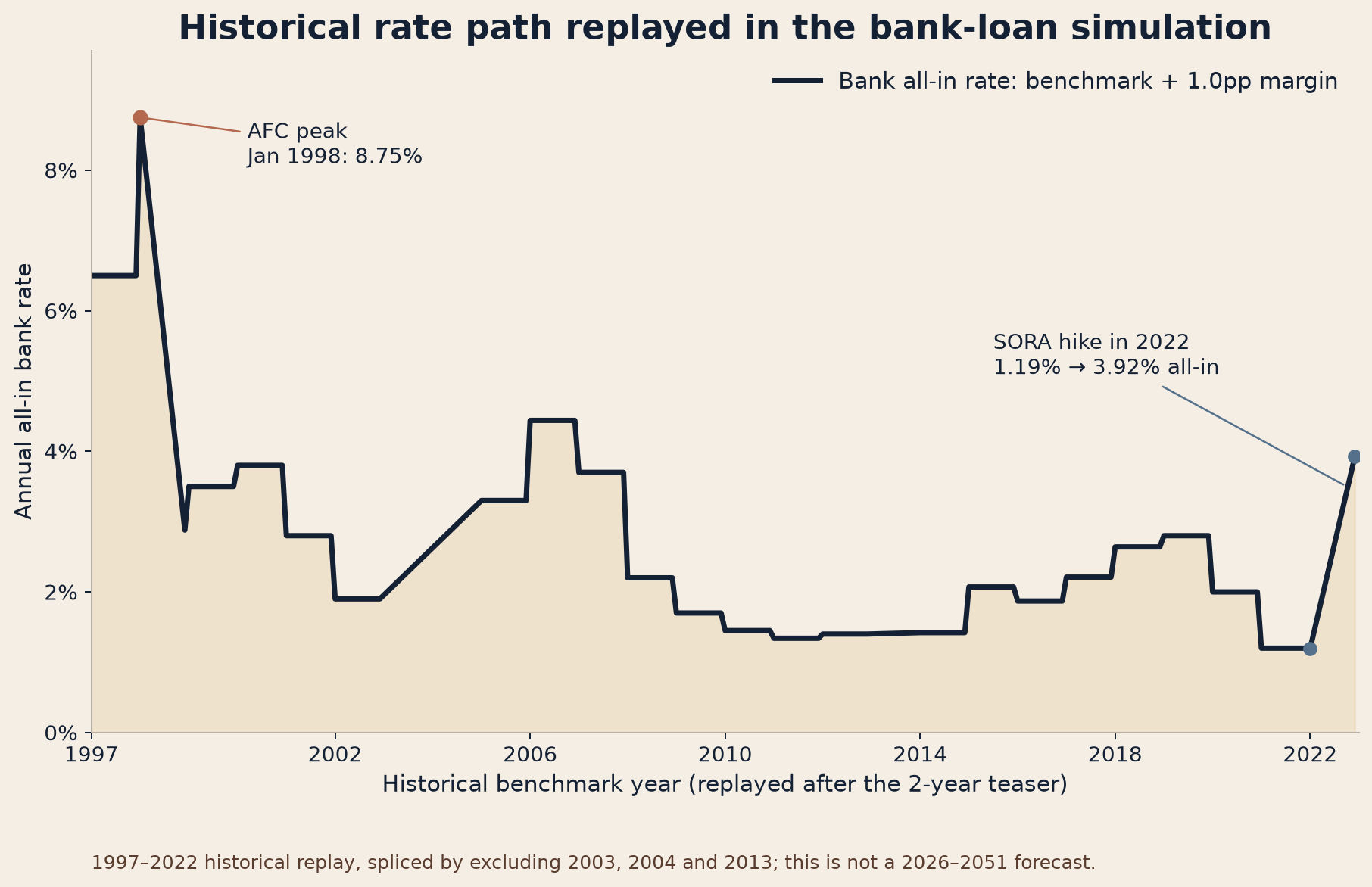
Nobody can know what SIBOR/SORA will do between 2028 and 2051, so this replays the actual past 23 years of Singapore benchmark-rate history (1997-2022) onto that post-teaser stretch — an illustration, not a prediction.
This specific window was chosen because it captures two real, opposite-direction stress events. At the start: the 1997-98 Asian Financial Crisis, when 3-month SIBOR spiked to roughly 7.75% in January 1998 (some sources cite figures as high as 9.5%-9.84% for the broader overnight rate) before crashing to 1.88% by December that same year — the crisis behind a real wave of forced property sales as floating mortgage payments suddenly jumped.11 Near the end: the 2022-23 SORA hike, when 3-month compounded SORA rose from 0.19% in January 2022 to roughly 2.92% by December 2022 — one of the sharpest rate-rise cycles in the benchmark's short history, and the most recent reminder of what a floating loan can do.13 The raw 1997-2022 span is 26 calendar years; fitting it into this loan's fixed 23-year post-teaser life meant dropping 3 of the flattest, least-informative interpolated years in the middle (2003, 2004, 2013 — none a directly-sourced anchor).
| HDB loan | Bank loan (floating, 1997-2022 replay) | |
|---|---|---|
| Total interest paid over 25 years | S$216,605 | S$246,522 |
| Interest as % of the S$800,000 purchase price | 27.1% | 30.8% |
| Peak all-in rate hit during the loan | 2.6% (never changes) | ~8.75% (Jan 1998, AFC crisis — the higher of the loan's two spikes) |
| Second spike, later in the loan | 2.6% (never changes) | ~3.92% (Dec 2022, tail of the SORA hike) |
| Lowest all-in rate hit during the loan | 2.6% (never changes) | ~1.19% (Jan 2022, just before the hike began — lower than the 2011 or 2021 lows) |
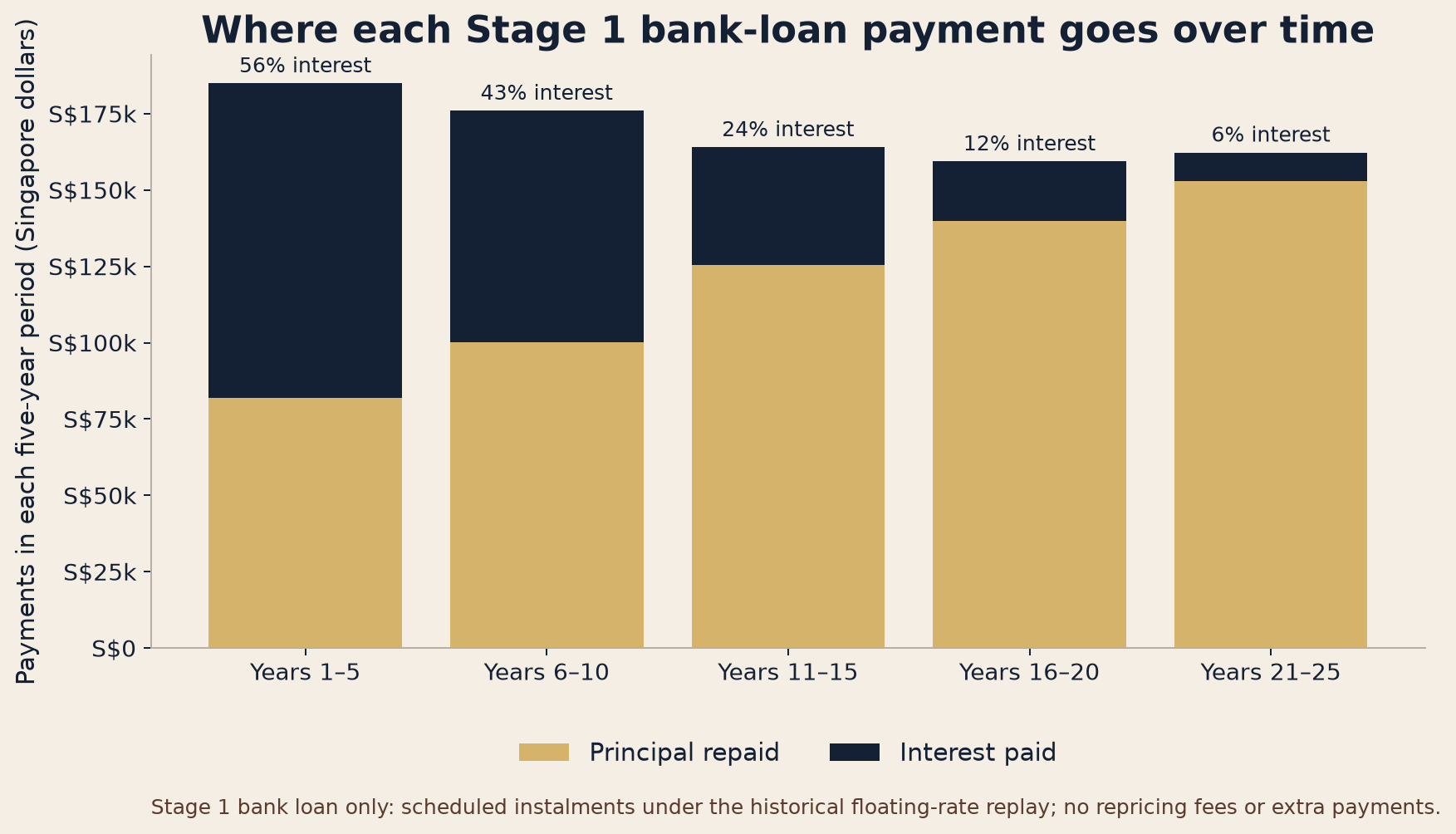
The bank loan pays roughly S$30,000 more interest in total over the 25 years than the HDB loan — interest running to about 30.8% of the purchase price.
Stage 2 — reprice every 2 years instead of riding the float
How repricing works
Running a raw floating rate for 23 straight years isn't what a rational borrower actually does. The norm is to reprice — switch to a fresh "special" rate with your own bank — at every lock-in expiry, rather than let the loan revert to whatever the board/floating rate happens to be. A typical special/repriced rate runs roughly 0.1-0.3 percentage points below the prevailing floating rate at the time (a "loyalty tax" gap between what new customers get and what existing non-repricing customers are quietly left on).12 Each reprice costs a modest ~S$650 admin fee.6
This stage rebuilds the bank-loan path: at every 24-month mark, the buyer reprices into a rate 0.2 percentage points below that moment's floating benchmark+margin, held flat for the next 24 months. One simplification worth flagging: this prices each repriced rate off the SPOT floating rate on the day it's set, minus the flat 0.2-point discount. A real bank prices a fixed-for-2-years package partly on where it expects rates to go next, not just where they are today — so this treatment is somewhat more generous to Stage 2 than a real bank would be during a period the market already expects to keep rising.
| HDB loan | Bank loan (repriced) | |
|---|---|---|
| Total interest paid | S$216,605 (no lock-in to reprice — unchanged from Stage 1) | S$237,447 |
| Interest as % of the S$800,000 purchase price | 27.1% | 29.7% |
| All-in total | S$216,605 | S$237,447 |
The timing risk
With the fee waived, repricing saves S$9,075 all-in here (S$237,447 vs Stage 1's S$246,522). That is this chosen historical splice, not a promise: rebuilding the same simulation across all 2,600 ways to pick which 3 of the 26 raw years to drop still finds repricing ahead in only 56% of them, with the gap ranging from about S$15,000 in repricing's favor to about S$54,000 in never-repricing's favor, depending almost entirely on which years survive the splice.
Across the wider sweep, the two rate paths are close to a coin flip, and the direction depends on where the 2-year lock-in boundaries happen to land relative to the rate spikes. Repricing's value is protection during a lock-in window that happens to coincide with a rise; its cost is being stuck at a rate just as the market is about to fall. The fee waiver makes this chosen splice more favourable, but does not erase that rate-timing risk.
Why savings stay small
The S$9,075 saving is smaller than a naive 0.2-point × S$550,000 × 23-year estimate (about S$25,300) because that uses the wrong balance: this declining loan's actual post-teaser average balance is S$316,950, so even a permanent 0.2-point cut would be only about S$14,580. It is not permanent here: each reset locks a new two-year rate. In 4 of 12 blocks, that lock cost more interest than Stage 1 as rates fell. A synthetic permanent 0.2-point cut saves S$15,546 — close to the balance-adjusted estimate. So this is rate-timing risk plus a lower average balance.
Fee waiver
Most banks waive this fee; check your Letter of Offer before treating S$0 as your own cost. OCBC and DBS describe package-specific terms, while Maybank's Green Home Loan waives every post-lock-in conversion fee for qualifying completed properties.14
Stage 3 — pay it off as fast as possible
A more finance-savvy version of the same buyer wants to stop paying so much interest, full stop — not just optimize the rate.
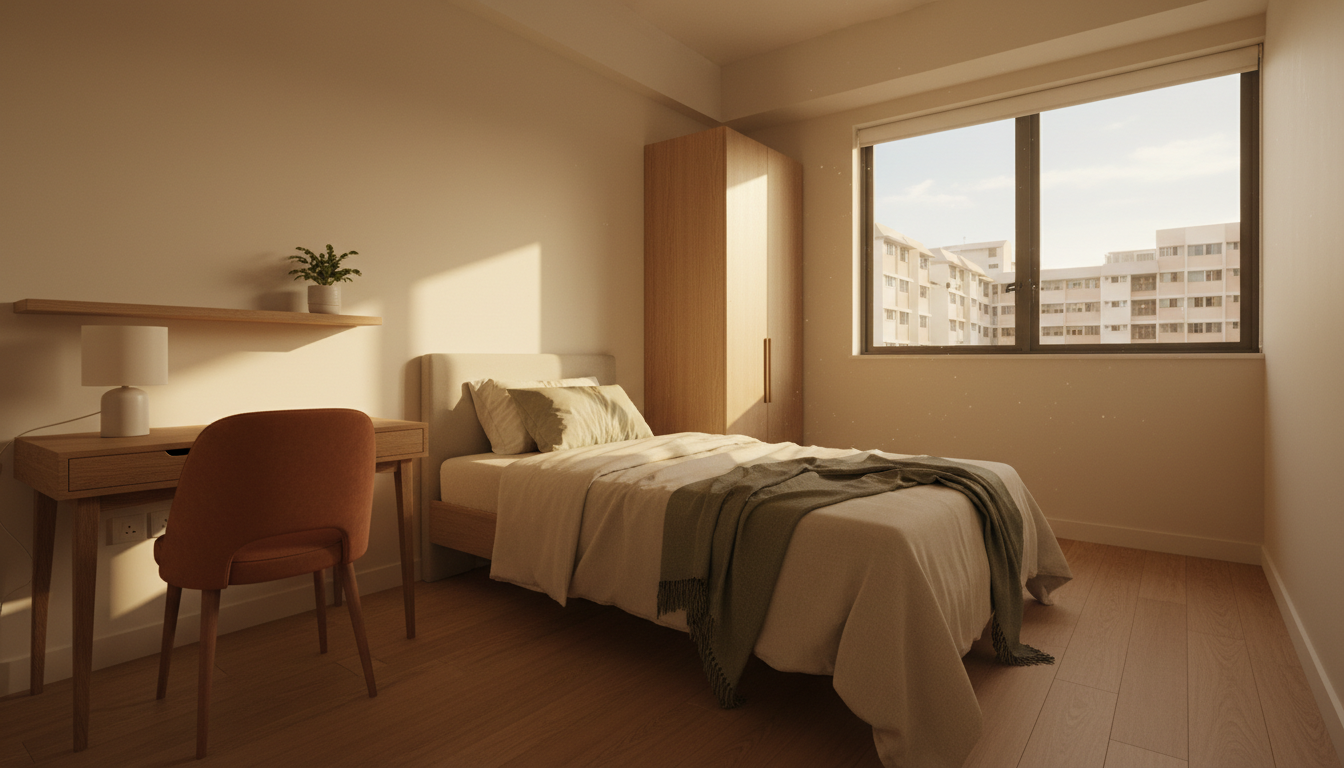
A spare room can turn a steady rental contribution into a disciplined extra-payment habit — but the mechanics of each loan still matter.
HDB prepayments
HDB side: the buyer sets aside S$1,000/month (the buyer's own idea: renting out a room to fund it). HDB's own prepayment rule isn't a literal $1,000/month payment, though — it's a minimum S$5,000 per prepayment, in S$1,000 multiples, any time, with zero penalty ever.7 So this is modeled as it would really work: S$5,000 paid into the loan every 5 months, starting at month 5.
If you'd rather put that same S$1,000/month into the market instead of the loan, this companion piece runs the actual 15-year numbers.
Bank prepayments
Bank side, for a fair comparison: instead of a savings habit, the buyer makes a S$24,000 lump-sum prepayment at every 2-yearly repricing — on top of the Stage 2 repricing pattern. Timed to land exactly at each reprice boundary, this avoids any early-redemption penalty (that penalty applies to prepaying during a lock-in, not to a lump sum paid at the natural point you're already switching packages).5
Both loans pay off before the full 25 years, which means some of the later scheduled prepayments/repricings never actually happen — the tables below count only the events that occur before each loan reaches zero balance.
| HDB loan (S$5,000 every 5 months) | Bank loan (repriced + lump sums) | |
|---|---|---|
| Total interest paid | S$139,979 | S$191,726 |
| Interest as % of the S$800,000 purchase price | 17.5% | 24.0% |
| All-in total | S$139,979 | S$191,726 |
| Time to pay off | 16 years 8 months | 21 years 11 months |
| Total extra paid in beyond scheduled instalments | S$200,000 (40 × S$5,000 — 40 events actually occur before payoff) | S$240,000 (10 × S$24,000 — 10 events actually occur before payoff) |
Why payoff speed differs
The bank loan needed 20% more extra cash (S$240,000 vs S$200,000) to close proportionally less of the gap with HDB. That's not because paying down a bank loan early is a bad idea — it's a real structural difference: HDB's instalment never needs recalculating (it's fixed for the life of the loan), so every extra dollar goes straight toward finishing early. A floating bank loan recalculates its required minimum instalment every time the rate resets, using the actual (already-reduced) balance — so part of each lump sum's benefit shows up as a smaller future instalment rather than purely an earlier finish date, unless the buyer deliberately keeps paying the old, higher instalment amount instead of dropping to the new lower minimum. This article doesn't assume that extra discipline; adding it would make the bank number look better.
All 6 numbers, side by side
| Stage | HDB loan — all-in interest cost | Bank loan — all-in interest cost |
|---|---|---|
| 1 — never touch it, 25 yrs | ~S$217,000 | ~S$247,000 |
| 2 — reprice every 2 yrs | ~S$217,000 | ~S$237,000 |
| 3 — pay it off fast | ~S$140,000 | ~S$192,000 |
(Rounded to the nearest thousand. The fee-waived Stage 2 figure saves roughly S$9,000 in this chosen splice, but the sensitivity sweep above shows that the direction still depends heavily on which historical years are included.)
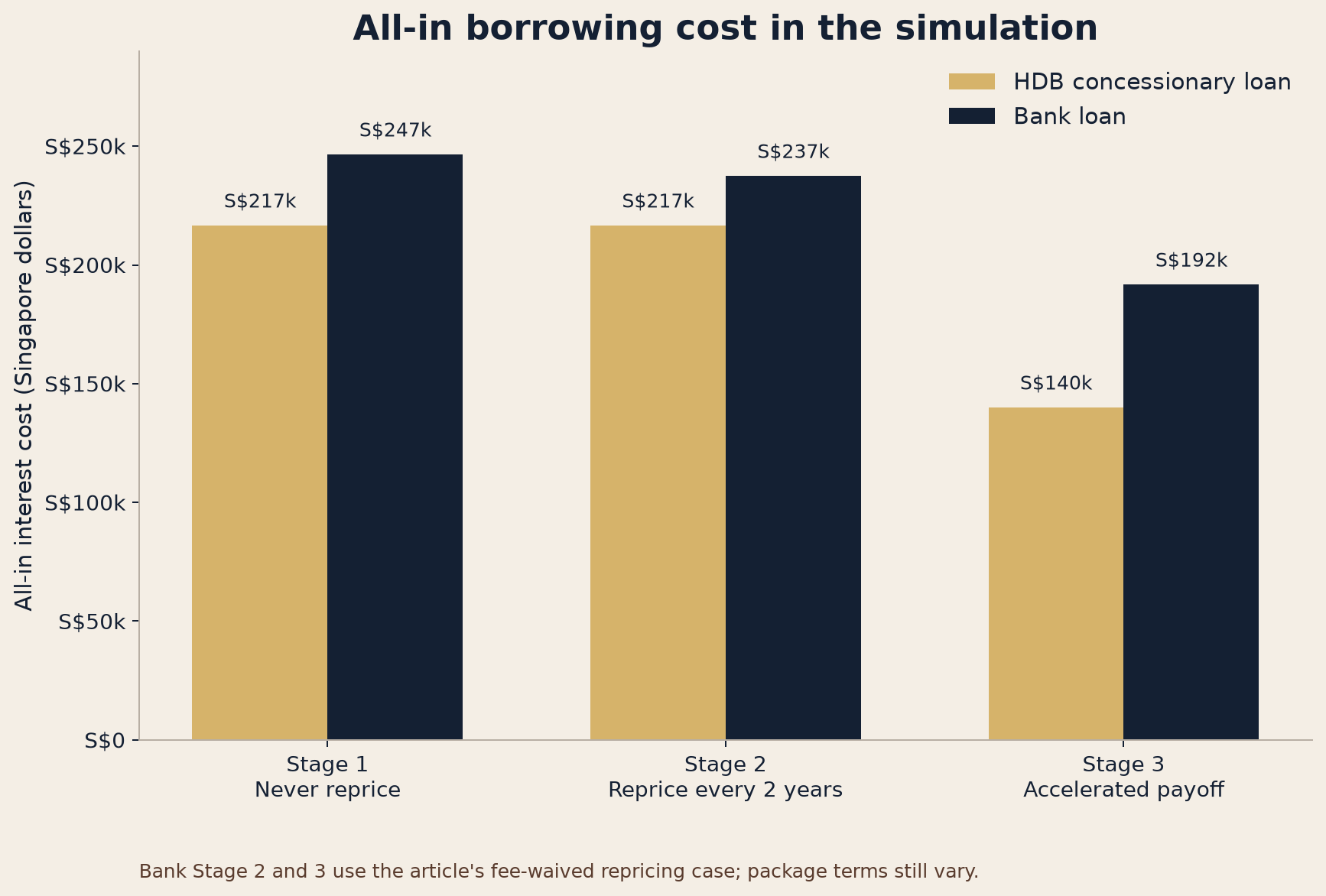
Two things stand out. First, in every stage, the HDB loan comes out ahead on total interest — not because 2.6% is always the lowest available rate, but because it's the same 2.6% for the entire 25 years, with an instalment structure that rewards paying extra without any recalculation eating into the benefit. Second, a fee waiver makes Stage 2 clearly cheaper in this chosen splice, but the sweep in Stage 2 shows that the rate-path result is not stable; aggressive prepayment (Stage 3) is the strategy that reliably closes real ground against HDB.
This is a simulation, not a forecast
Every dollar figure above comes from a real, re-runnable Python amortization script, using actual historical Singapore interest rate data — not invented numbers. It is still a stylized illustration, not a prediction of this buyer's actual 2026-2051 mortgage:
- The 1997-2022 rate path is the real past, replayed onto a loan starting in 2026 — the closest genuine crisis-tested reference available, since nobody can know the real 2026-2051 path. As Stage 2 shows, this window's own precise composition still swings the Stage 1-vs-2 result by tens of thousands of dollars.
- The bank margin (fixed at +1.0 percentage point) and the reprice discount (fixed at -0.2 percentage points) are representative points within sourced ranges, not universal constants — your own Letter of Offer's numbers will differ.
- "Never repricing" here means riding the true benchmark+margin floating rate. Some real bank packages instead revert to a higher internal "board rate" if left untouched, which would make Stage 1's bank number worse than shown here.
- No income tax, no changes to the buyer's life circumstances over 25 years — an interest-and-principal-only lens on one decision.
Not financial advice
This is a mechanics-and-numbers illustration, not a recommendation for your own situation. Your own eligibility, your own bank's actual package terms, and your own life plans over the next 25 years will all differ from this one hypothetical buyer. Before choosing between an HDB loan and a bank loan, or before starting a repricing or accelerated-payoff strategy of your own, speak with your HDB loan officer for the concessionary-loan side, and a licensed bank mortgage specialist or an FAA-licensed financial adviser for the bank-loan side.
Sources
-
HDB and bank loan LTV limit, both 75% since 20 August 2024: HDB's own 19 August 2024 press release; corroborated by ERA Singapore Property Research and PropertyLimBrothers Insights. ↩
-
HDB concessionary rate = CPF Ordinary Account rate + 0.1 percentage point, currently 2.6% p.a. (2.5% OA floor + 0.1%): CPF Board's "CPF interest rates from 1 July to 30 September 2026" release, mirrored on hdb.gov.sg. ↩
-
HDB rate unchanged since 1999 (27 years to 2026): cross-checked across multiple SG mortgage-guide sites. ↩
-
Current bank fixed-rate band ~1.40%-1.80% p.a., used as the source for this article's 1.45% representative 2-year special rate: DollarBack Mortgage and MoneyDigest.sg. ↩
-
Bank loan early-redemption penalty, typically 0.75%-1.5% of the amount prepaid/redeemed during lock-in — does not apply to a lump sum paid exactly at a natural repricing/package-switch point: DollarBack Mortgage and Cashew.sg. ↩
-
Repricing admin fee, same bank, ~S$500-800 (this article uses S$650): Redbrick.sg and SmartCalculator.sg. ↩
-
HDB loan prepayment rule: any time, minimum S$5,000 per prepayment (S$500 for loans before 1 April 2012), then S$1,000 multiples, zero penalty — this article's Stage 3 models the real rule (S$5,000 every 5 months), not a literal $1,000/month payment: DBS Singapore's own page distinguishing HDB's concessionary-loan rule, cross-checked against Cashew.sg. ↩
-
HDB concessionary loan eligibility for a single buyer aged 35+: household income ceiling S$7,000/month, at least one Singapore Citizen buyer, 30-month no-private-property rule: Homejourney.sg, cross-checked against CPF Board's own comparison page. ↩
-
HDB concessionary loan max tenure (25 years, and tenure + youngest borrower's age ≤ 65) and bank loan max tenure on an HDB flat (30 years, subject to the LTV rule in 10): Cashew.sg — "What Is The Maximum Loan Tenure I Can Get In Singapore?", cross-checked against dollarsandsense.sg — "Understanding Loan-To-Value (LTV) Limit & Total Debt Servicing Ratio (TDSR)". ↩↩↩
-
Bank-loan LTV limit drops from 75% to 55% once tenure exceeds 25 years for an HDB flat (or extends past the borrower's 65th birthday) — a real MAS/HDB macroprudential rule, not a hypothetical: dollarsandsense.sg (same article as 9), cross-checked against Cashew.sg. ↩↩
-
1997-98 Asian Financial Crisis: 3-month SIBOR peaked at roughly 7.75% in January 1998, falling to 1.88% by December 1998 (alternative figures of 9.5% and a broader-benchmark 9.84% also appear in some sources for the same event and are disclosed rather than dropped): housingloansingapore.com — "SIBOR Rate Singapore | SOR Rates | Latest Chart History Trends", cross-checked against iqrate.io, thekopinotes.com, moneylobang.com, and tradingeconomics.com/singapore/interbank-rate. ↩
-
Reprice/"special" rate discount below the prevailing floating rate, ~0.1-0.3 percentage points (a "loyalty tax" gap between new-customer acquisition rates and existing-customer retention rates): synthesized from current SG mortgage-guide commentary. ↩
-
2022-23 SORA hike, 3-month compounded SORA: rose from 0.194% on 3 January 2022 to 2.924% on 1 December 2022 — one of the sharpest rate-rise cycles in the benchmark's short history, part of the global 2022-23 central-bank hiking cycle: DBS Singapore's own published "3-month SORA rates" table, cross-checked against a separately-sourced mid-December 2022 reading of 3.09%. ↩
-
Current lender repricing-fee examples, checked 7 September 2026: OCBC Home Loan Repricing — S$500 unless the existing package permits a one-time fee-free switch; DBS Home Loan Repricing — about S$800 administration fee for HDB flats; Maybank Green Loans — conversion fee waived at every reprice for completed Green Mark-certified properties. These are product/package terms, not a universal bank-loan rule. ↩