
What if the rules change after you are already in?
You spent years building a business in Indonesia. Most of what you own is in rupiah, under Indonesian rules, and your children are still studying. Then you read that on 24 October 2026 Indonesia cut part of the gas it sends by pipe to Singapore. You do not run a power station, so why does it feel personal? Because a quieter question follows: if a supply deal can change, can the rules change for me too, after I am already in?
Nobody can tell you which rule changes next. Spreading risk means limiting how much one decision can reach while Indonesia stays home.
The five lawful ways are foreign money, regular income, rent, precious things and children. None picks a bank, fund, coin or country.
Ibu Sari is a Surabaya business owner. Her savings are mostly rupiah; Rina and Bayu are at university. Her business stays at home. The question is how the family can lawfully reach its assets.
The five ways at a glance
- Way 1, foreign money: part of your savings in another currency, such as US dollars, at home or abroad. Not removed: currency risk; an account at home still follows Indonesian rules.
- Way 2, regular income: interest or dividends paid from outside Indonesia, in another currency. Not removed: Indonesian tax; a borrower can fail and a dividend can be cut.
- Way 3, rent: income from property, in Bali or abroad. Not removed: each place's buyer rules, licences and taxes; property is slow to sell.
- Way 4, precious things: gold, art, collectibles or digital coins kept for their value. Not removed: they pay nothing while you hold them; buying and selling cost money.
- Way 5, your children: education abroad, and a plan for how they can legally reach the family's assets. Not removed: Indonesian tax duties, which do not end automatically; permission to live abroad is never automatic.
Ways 1 to 4 spread where the money sits. Way 5 is about whether your children can reach it.
Why does Singapore say it still has enough gas?
First, the news, as reported (all read 27 October 2026). SKK Migas gave reliable domestic electricity supply as its reason for the cut; the Energy Ministry's 26 October record says the reduction was to secure supply for PLN and domestic industry (CNBC Indonesia, 24 October 2026). Singapore's Prime Minister said the gas is covered by commercial contracts; Singapore's Foreign Ministry later recorded a shared commitment to honour them (Jakarta Globe, 26 October 2026; MFA, 28 October 2026). The energy minister said the cut stayed within the contract's minimum.
Whether it fits the contract is for the two sides to settle; this article makes no breach finding.
Here is the surprise. More than 95% of Singapore's electricity comes from gas (SG101, energy, a Singapore government site), yet its Energy Market Authority said this reduction was "less than 2 per cent" of daily gas demand (Mothership, 24 October 2026). That is the regulator's assessment; no report read measures an effect on prices or households.
The reason is a terminal for liquefied natural gas, gas cooled into a liquid so ships can bring it from anywhere. The government told Parliament that the terminal "started operations in 2013" and "allows us to import LNG from various suppliers around the world", and that "in 2024, no single country accounted for more than 30% of our gas imports" (ministry oral reply, read 28 October 2026).
Think of it as water through pipes: with many pipes, one cut matters less. That is the whole idea of this article, applied to your money. It is an image, not a promise: every pipe has its own costs, taxes and rules, and Singapore's own spread came at a price, as the next section shows.
Why spread at all? Rules that changed for people already invested
Rules change in every country, and a change alone is not a reason to worry. A new tax rate or a new form changes how you work.
Some actions go further and change who controls an asset. Singapore has made sudden changes too, shown below; this list starts with Indonesia only because that is where your assets are. Each case came with a stated reason, and this article does not judge whether any change was right.
Tax, at short notice. A rise in value added tax (VAT) from 11% to 12% was due on 1 January 2025. Hours earlier, it was limited to luxury goods and services (Cabinet Secretariat, 31 December 2024; The Jakarta Post, 1 January 2025). When Coretax started that January, a taxpayers' association chair said some businesses "can't generate invoices" and the Finance Minister apologised (Asia News Network, 31 January 2025).
Export money kept at home. From 1 March 2025, Government Regulation 8 required covered natural-resource exporters to place proceeds in Indonesian bank accounts for 12 months. Oil and gas were excluded. The money could still be used for specified operations, taxes, dividends and some loan repayments. The government cited development financing, reserves and exchange-rate stability; its 17 February announcement gave exporters about twelve days to prepare (Cabinet Secretariat, re-read 28 October 2026). This is a 2025 example, not today's-rule advice: The Jakarta Post reported tighter rules from 1 January 2026, whose final text is not covered here.
Permits. On 6 January 2022 President Joko Widodo said the government had revoked 2,078 mining permits "because they never submitted a work plan" (Antara, 6 January 2022).
Plantation land. This is the case where control changed hands: land used under plantation permits went under state control while some permit holders challenged the action. The stated reason, from a government task force on forest areas, is that the land lies inside state forest areas; the task force has taken it back, and the Attorney General described the work as enforcing the law so natural wealth is used "untuk kepentingan masyarakat yang luas" (for the wide public interest) (Antara, 13 May 2026).
Fortune IDN reported more than 6 million hectares taken back by October 2026, with some transferred to Agrinas Palma Nusantara (7 October 2026). GAPKI supported enforcement but asked that permit history count; Kontan reported one company suing the task force, with no outcome found (8 March 2025; 31 August 2026). Who is right is for the courts.
Singapore, too. Singapore doubled its foreign buyer's tax on homes from 30% to 60% with one day's notice in April 2023, with a written transition for buyers already in a deal (MAS and two ministries, 26 April 2023). Singapore has also relied on a construction material: an official SG101 archive says sand from Tampines was used to build HDB towns in the 1960s, and that there were 26 sand quarries there at the peak (SG101, Tampines).
Its many gas suppliers have a cost as well: the same government site says that, depending on imported LNG, Singapore "has little control over energy prices" (SG101, energy).
So the question is not whether a rule is fair. It is how much of what you own one decision can reach.
Back to Ibu Sari's question, then: if your wealth is mostly in Indonesia, how can you spread risk without leaving home?
Way 1: foreign money
Way 1 means keeping part of your savings in a currency other than rupiah, such as US dollars. Ibu Sari already keeps US dollars at her bank in Surabaya.
That is allowed. Law No. 24 of 1999, Article 2(1), says "Setiap Penduduk dapat dengan bebas memiliki dan menggunakan Devisa" (every resident may freely own and use foreign exchange), as published in the Ministry of Finance legal database (Law No. 24 of 1999, read 28 October 2026). Owning dollars does not make them legal money for everyday payments: the Currency Law requires rupiah for payments in Indonesia (Law No. 7 of 2011, Article 21(1), as quoted by Hukumonline), while Bank Indonesia lists foreign-currency bank deposits among the exceptions (Bank Indonesia, PBI 17/3/PBI/2015 summary, page updated 18 July 2026, read 28 October 2026).
But Ibu Sari's dollar account still follows Indonesian rules. Another currency is not another country's rules. And a foreign currency can lose value too:
Rupiah per one unit of each currency, 2006 and 2025, and the change in the rupiah's value against it:
- US dollar: 9,170 and 16,478; -44.3%.
- Singapore dollar: 5,771 and 12,608; -54.2%.
- Australian dollar: 6,904 and 10,621; -35.0%.
- Swiss franc: 7,315 and 19,829; -63.1%.
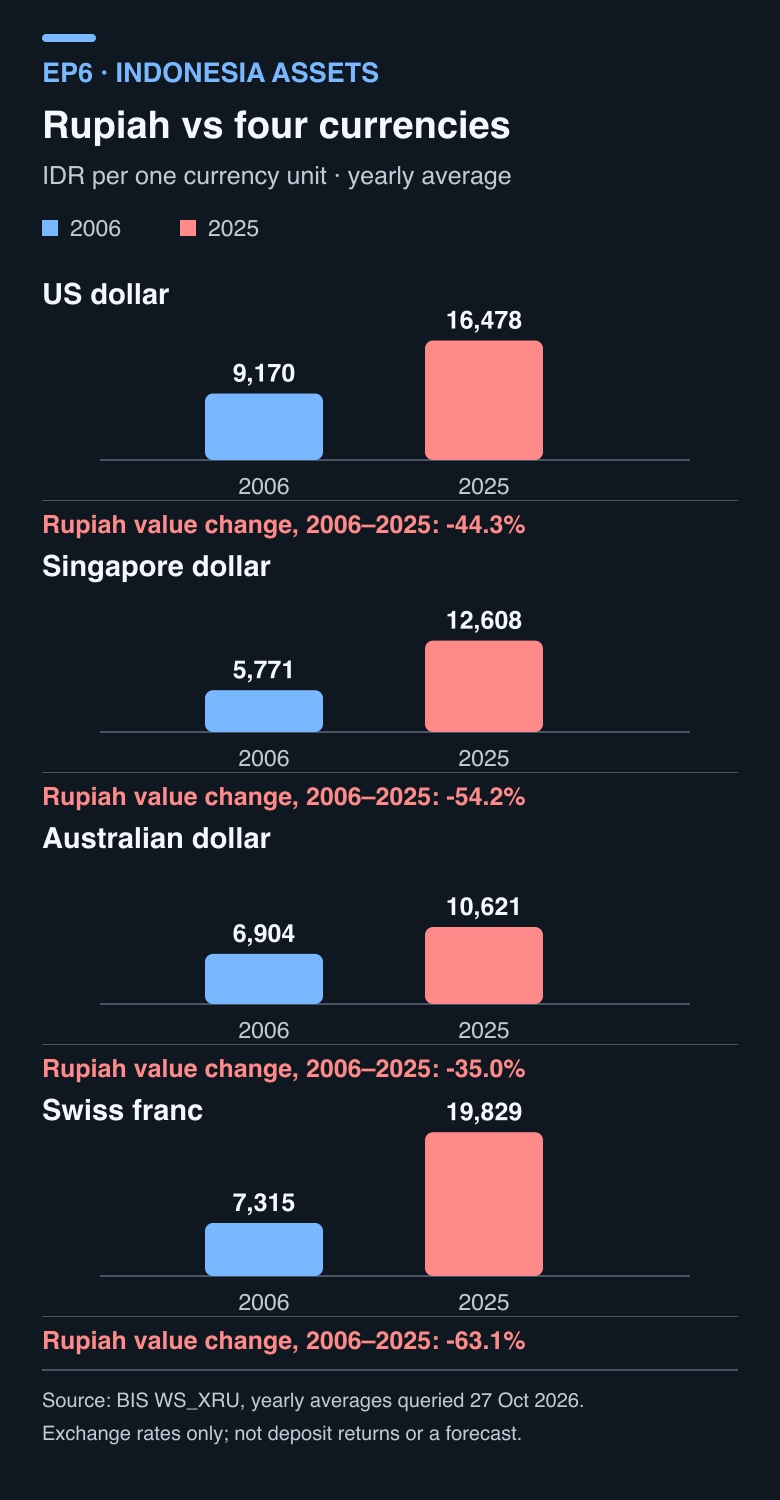
Yearly averages computed by us from BIS series WS_XRU (query run 27 October 2026). Exchange rates only, not the return on any deposit. The rupiah strengthened from 2008 to 2010, and the Singapore dollar lost about 9.5% of its US-dollar value from 2012 to 2016; past movement is not a forecast.
So where else can foreign money sit? Four forms, each with its own catch (all pages below read 28 October 2026):
- A bank account abroad. Each bank decides. Singapore bank pages usually ask for a pass to live or work there, or evidence of a plan to move (DBS; OCBC; UOB). Two banks in Dubai say non-residents may open savings accounts, with documents such as recent bank statements and, at one bank, a minimum balance of AED 3,000 (Mashreq; Emirates NBD key facts statement). OCBC describes remote opening for eligible Indonesian e-passport holders who can document plans to relocate to Singapore. That does not establish an account-opening route for Ibu Sari if she has no plan to move. The Dubai pages do not establish fully remote opening.
- A broker abroad, a firm that holds money and handles investment purchases. Its account can hold US dollars and buy investments later. In July 2022 an official of OJK, Indonesia's financial regulator, said marketing foreign securities in Indonesia was not permitted (CNBC Indonesia, 9 July 2022, a news report). That warning concerns selling to people in Indonesia; it does not decide whether an individual may open an account abroad, and no rule banning that was found.
- A stablecoin, a digital coin designed to stay equal to the US dollar. OJK took over crypto supervision on 10 January 2025 (official OJK joint handover release, 10 January 2025), but crypto is not legal money for payments (Kompas TV, 11 May 2021). A stablecoin depends on the company behind it: on 11 March 2023 one well-known stablecoin briefly traded at 87 cents (CoinDesk, 11 March 2023). From 1 August 2025, crypto sales carry a final income tax of 0.21% through licensed domestic platforms and 1% through a foreign platform (DJP, revised 8 September 2025). No coin is named here.
- Cash, US dollar notes you keep yourself. Anyone carrying Rp100 million or more in cash into or out of Indonesia must declare it to Customs (Republika, 22 April 2025), and Bank Indonesia bars individuals from carrying foreign notes worth Rp1 billion or more across the border (Cabinet Secretariat, 14 March 2018). Singapore asks travellers with more than S$20,000 to declare it (ICA, updated 29 September 2026). Notes pay no interest, and cash at home still follows Indonesian rules. For an account, any interest and the currency it is paid in depend on the account's terms.
Ibu Sari's choice: she keeps the dollar account she has, and before opening anything else she finds out two things: which banks abroad would accept someone who lives in Indonesia, and how Rina and Bayu could reach the money. Children need account records and whatever documents a bank requires to release money after a parent's death. In Singapore, some sole and joint bank accounts that meet the bank's guidelines may pass without a court grant (Judiciary, Probate and administration, updated 15 October 2024, read 27 October 2026).
Way 1 puts part of your savings in another currency. Holding it abroad also brings another country's rules.
Way 2: regular income
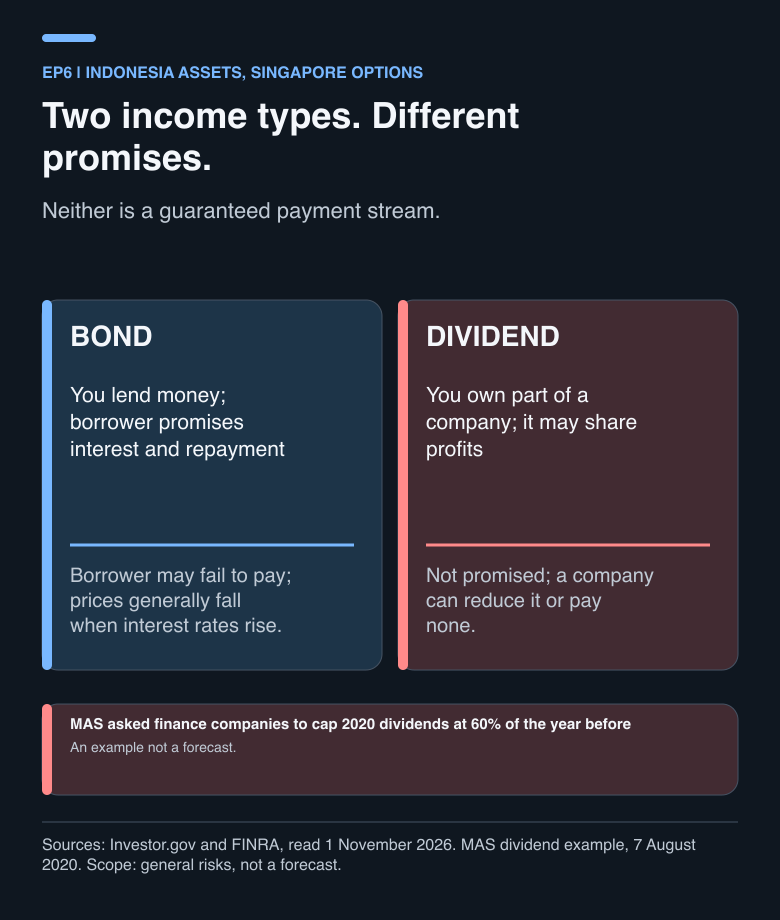
Way 2 is money that keeps arriving while you own something, paid from outside Indonesia in another currency. A bond is a loan. The borrower promises interest, called a coupon, and repayment of the amount borrowed at the end, but may fail to pay. The US regulator's investor site calls it "a debt security, like an IOU" (Investor.gov, bonds, read 28 October 2026). A share is part-ownership of a company and can pay dividends, payments from profits.
A dividend is not promised. A company can reduce it or pay none. In 2020, Singapore's MAS asked finance companies to moderate dividends, including a cap at 60% of the previous year's dividend (MAS, 7 August 2020). That was a pandemic-period regulatory request, not a forecast for any company. "When interest rates rise, bond prices generally fall", so selling before repayment can mean a loss (FINRA, bonds, read 28 October 2026). Some shares pay high dividends, but a large past payment does not promise the next one.
Why not Indonesian government bonds? The Finance Ministry's ORI024 presentation places ORI under rupiah government bonds and says its coupon is fixed; ORI024 can be traded between domestic investors. It is a rupiah option for local-currency income, but does not move that part of Ibu Sari's money into another currency or another country's rules (Finance Ministry, ORI024 presentation, pp. 3 and 8). Foreign bonds can pay in dollars or another currency, depending on their terms. This is a comparison of jobs, not a judgement that one is better.
Tax, in two places. The investment's home country may take tax before the payment reaches you, and each country sets its own rate. The same dividend therefore reaches you as different amounts:
- Singapore. Dividends from a Singapore resident company under its one-tier system are not taxable, "as the tax paid by a company is final" (IRAS, dividends, updated 27 February 2026, read 27 October 2026).
- Hong Kong. The government's financial services bureau states there is "no withholding tax on dividends and interest" (Financial Services and the Treasury Bureau, prevailing tax policy, page last revised 21 April 2021, read 28 October 2026).
- United States. Most US-source income of a foreign person is taxed at 30%, unless a treaty lowers it (IRS Publication 515, read 27 October 2026).
And Indonesian tax can still apply at home: the Income Tax Law taxes residents on income "baik yang diterima atau diperoleh dari Indonesia maupun dari luar Indonesia" (whether received from Indonesia or from outside Indonesia) (Law No. 7 of 1983 as amended to Law No. 11 of 2020, DJP consolidated text, read 28 October 2026; this text predates the 2021 tax harmonisation law). Indonesia's tax treaties may lower some foreign rates. Foreign-dividend treatment can depend on reinvestment conditions and the rules that apply to you; this article does not calculate your Indonesian tax.
Ibu Sari compares what reaches her after tax, not a headline rate. Way 2 means income in another currency, with tax and payment risk still attached.
Way 3: rent, in Bali or abroad
Rent at home. Rent does not have to come from abroad. Take Bali. A villa there spreads where your guests come from, but the rules are still Indonesian, and payments inside Indonesia are made in rupiah. Its place in a plan is rent from guests who come from other countries, often advertised in US dollars, earned from an asset at home.
As an Indonesian citizen, you can hold land there with full ownership, hak milik, which for individuals is reserved for citizens: "Hanya warga-negara Indonesia dapat mempunyai hak milik" (only Indonesian citizens may hold hak milik) (Basic Agrarian Law, Law No. 5 of 1960, Article 21(1), as read on pasal.id on 28 October 2026). A foreigner may hold only more limited rights (Hukumonline, 30 March 2021).
Rupiah is required even when the rent is advertised in dollars: in June 2026 Bank Indonesia in Bali repeated that tourism transactions must use rupiah (ANTARA Bali, 20 June 2026). For a villa operated as tourist accommodation, licensing and local accommodation-tax rules matter. Law No. 1 of 2022 includes villas in accommodation services and sets a national PBJT ceiling of 10%, with the rate fixed by local regulation; this article does not establish a particular villa's 2026 liability (Law 1/2022, Articles 53 and 58, read 28 October 2026 from the Internet Archive copy of 30 September 2026). In February 2026 Bali's governor asked platforms, including Airbnb, to remove accommodation that is not licensed and tax-paying (ANTARA Bali, 12 February 2026). Ibu Sari had never thought of a villa at home as a way to spread risk.
Abroad. A property abroad follows that country's rules, and the payment currency is a separate question. Japan is one example of renting abroad because it has a national home-sharing law for short-stay letting: up to 180 rental days a year, and local rules can be stricter (Japan Tourism Agency). A non-resident acquiring property in Japan must generally report the acquisition to the Minister of Finance through the Bank of Japan within 20 days. The June 2026 leaflet separates acquisitions before and after 1 April 2026; its later exceptions concern specified rights to property, so buying a home for your own or your family's use is not a blanket exemption (Ministry of Finance Japan leaflet, June 2026, read 31 October 2026). That leaflet is a reporting rule, not a full statement of who may buy, and no official page setting out every buyer rule was found.
Contracts transferring or creating rights in real estate in special monitored areas require notification; such areas may be designated near important facilities or on remote territorial islands (Cabinet Office, land-use law, read 1 November 2026).
And Singapore? A foreigner normally pays an extra buyer's tax (Additional Buyer's Stamp Duty, ABSD) of 60% on any Singapore home, on the higher of the price and the market value (IRAS, ABSD, last updated 27 August 2026, read 28 October 2026). Put on a scale: if the price and market value both equal 100, the tax raises the cost to 160, before other costs. The same rent then has to cover 160 instead of 100. For example, rent of 4 a year for every 100 of price becomes only 2.5 a year for every 100 the buyer actually paid. Illustrative numbers, not a market rent; computed by us from the IRAS rate. Normal stamp duty and other costs lower it further.
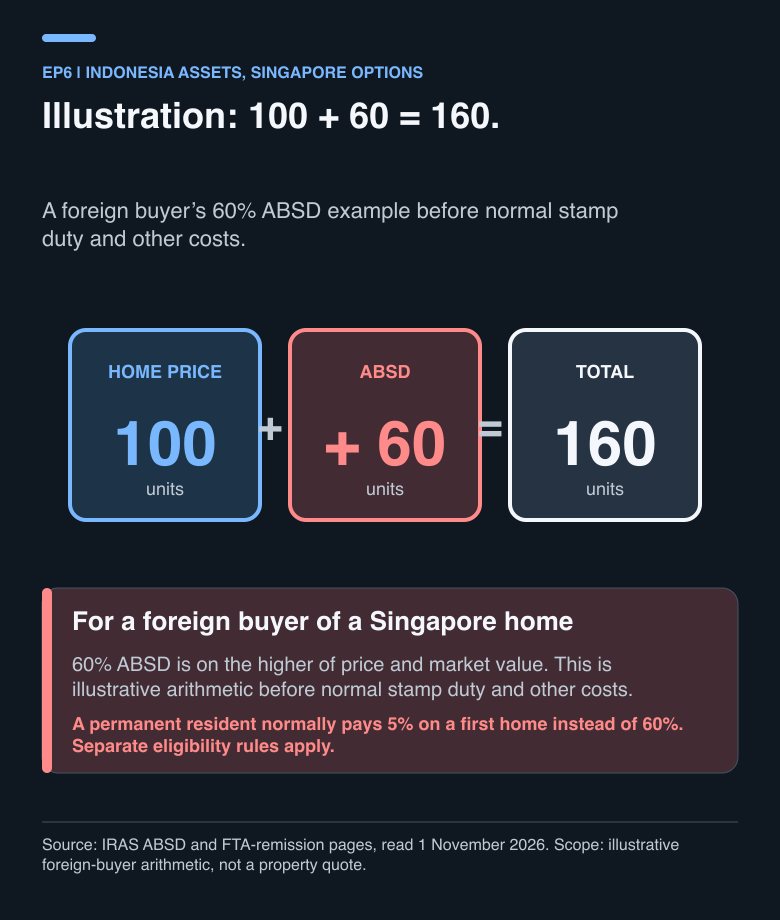
That tax applies to homes only. Commercial property, such as an office or a shop, does not attract it, and a foreigner may buy commercial property without approval (SLA, foreign ownership of property, read 28 October 2026). Two published rules change the home rate for some people. A permanent resident, someone allowed to live in Singapore long term without becoming a citizen, normally pays 5% on a first home instead of 60%. And under trade agreements, nationals of the United States, and nationals or permanent residents of Iceland, Liechtenstein, Norway or Switzerland, get "the same stamp duty treatment as Singapore Citizens" (IRAS, FTA remission, updated 30 January 2026, read 28 October 2026). Indonesia is outside those agreements.

Children inheriting a property need its ownership papers and must follow the local transfer rules. In Singapore, a foreign beneficiary of a restricted property, such as a landed home, may keep it subject to approval; otherwise the personal representatives must dispose of the foreign beneficiary's interest within five years of the death, and may apply for more time (SLA, Land Dealings Approval Unit FAQs, read 1 November 2026).
Way 3 means income from property, in Bali or abroad, under each place's rules.
Way 4: precious things
Way 4 is value you can hold: gold, art, collectibles or digital coins. Simply holding them pays no interest, dividend or rent, their prices can fall, and buying and selling cost money.
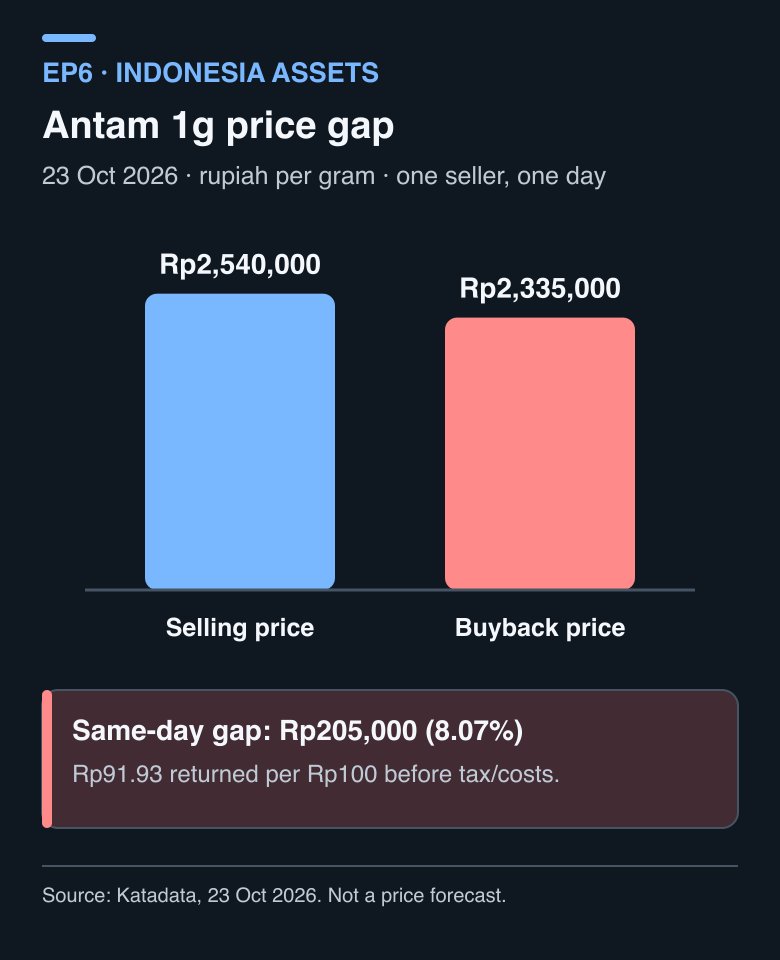
Gold. On 23 October 2026, Katadata reported Antam's 1-gram gold selling price at Rp2,540,000 and its buyback price at Rp2,335,000 (Katadata, 23 October 2026). The date-specific official price archive was not available when this article was checked; ANTAM's official pages confirm that its buyback price follows the transaction-day price (Logam Mulia FAQ). The gap is about 8% of the reported selling price. Put on a scale: for each 100 paid, selling straight back that day returned about 92, before tax and costs, with no change in the gold price at all. Computed by us from the reported prices: 205,000 / 2,540,000 = 8.07%; one seller, one day.
Art and collectibles are harder to sell and harder to check. Auction houses add a buyer's premium on top of the hammer price: The Art Newspaper reported that from 13 February 2026 Sotheby's New York buyer's premium was 28% on hammer prices up to US$2 million, with lower percentage tiers above that (The Art Newspaper, 17 February 2026). With trading cards such as Pokemon cards, checking that an item is real and finding a buyer are separate jobs. As a selling-cost example, eBay.com's standard card-category schedule lists 13.25% on the total sale amount up to US$7,500, plus a per-order charge; account type, selling site and other fees can change the total (eBay.com selling-fee schedule, read 28 October 2026). No auction house, grader or marketplace is recommended here.
Digital coins. A cold wallet keeps the coins' access codes offline, often on a physical device. A private key is the secret code that controls the coins. The US Securities and Exchange Commission's investor bulletin says "If you lose your private key, you permanently lose access to the crypto assets in your wallet", while a "seed phrase" can restore a lost wallet (Investor.gov, crypto custody, 12 December 2025, re-read 28 October 2026). So losing the code and every recovery backup can mean losing access for good. In May 2026 OJK listed crypto risks including "fluktuasi harga yang ekstrem" (extreme price swings) and potential fraud (OJK, 4 May 2026).
Ibu Sari records where valuables are kept and how the family can lawfully reach them. Way 4 holds value without paying income; digital coins are reached through codes, not the device. Even if money is spread, how would the children reach it?
Way 5: your children
Way 5 is planning your children's opportunities and their access to family assets. For Ibu Sari, this is the way that deals directly with how her children can reach what she built, and it takes the longest. That is her family priority, not a ranking of investment returns. Her real worry was never only the money; it was Rina and Bayu.
Education abroad. Rina wants to study law, and Bayu wants to study accounting. Studying in another country can give children another language, new friends and a different way of working. For scale, 8,104 Indonesian students were in the United States in 2024/25 (IIE Open Doors, Indonesia fact sheet 2025). But education abroad, permission to live abroad and inheritance are separate parts of a family plan.
Permission to live abroad. Does studying abroad give the whole family permission to live there? No. In Singapore, holders of an Employment Pass or S Pass, both work passes, may apply for permanent residence, and so may students studying in Singapore who have passed at least one national exam (ICA, apply for PR, updated 13 March 2026, read 28 October 2026). Applying is not approval. Family coverage is limited: a permanent resident may sponsor a spouse or an unmarried child under 21, and a citizen aged 21 or older may sponsor an aged parent; approval is separate each time (same ICA page). A male child granted PR through a parent may be liable for National Service, subject to ICA's stated eligibility and exemption rules; that is a family-planning consequence, not a guarantee about an individual case (same ICA page).
Another citizenship has a cost of its own. An adult Indonesian who voluntarily takes another citizenship loses Indonesian citizenship (Law No. 12 of 2006, Article 23(a), signed text, read 25 October 2026). Within one year of losing it, an owner must give up hak milik, or the right ends and the land falls to the State (Basic Agrarian Law, Article 21(3), as read on pasal.id on 28 October 2026).
How the children receive the assets. So what happens if Ibu Sari dies? Whatever she holds in the first four ways, her children will one day need to reach it.
One point matters most here: a grant issued abroad is not automatically a Singapore grant. Section 47 provides a route for grants from Commonwealth courts and declared places, but the statutory page was access-blocked when checked. This article therefore does not say whether an Indonesian grant can be resealed. The official Judiciary guide explains Singapore's separate probate process; a family with Singapore assets may need a Singapore application after completing Indonesian paperwork (Probate and Administration Act, section 47, access rechecked 1 November 2026; Singapore Judiciary probate guide). For the guide's valid-will, named-executor process, the Judiciary estimates about two to three months depending on complexity, not a timetable for every cross-border estate (How to file for a Grant of Probate, updated 5 June 2026).
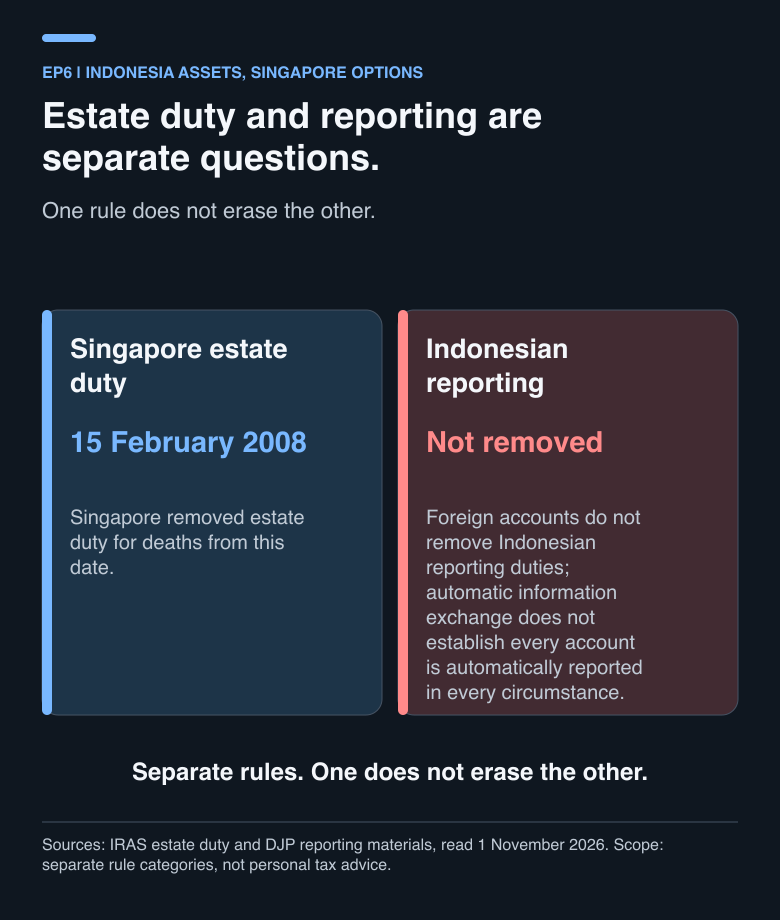
At home, Indonesia's inheritance division follows three legal systems: customary law, Islamic law and the Civil Code (Hukumonline, 6 November 2022), and which one applies can depend on the family's religion (Hukumonline, 31 May 2024). Singapore has a written court process, and its courts publish the steps. Some Singapore assets need a court grant, a document allowing someone to handle a person's assets after death; a home in one person's name generally needs one (Judiciary, Probate and administration). Singapore removed estate duty, a tax on assets at death, for deaths from 15 February 2008 (IRAS, estate duty, updated 9 March 2026).
Written family rules. A family agreement records who decides.
A trust places assets with someone who must manage them for named people under written terms: in a trust, "your appointed trustee takes ownership of your assets and manages them in the best interest of your beneficiaries" (MoneySense, What is a trust?, read 28 October 2026). Either can reduce the risk of a dispute; neither removes the inheritance rules that apply.
Ibu Sari keeps her business at home and asks of each asset: where it sits, whether there is a will in that country's form, and who will carry it out. Way 5 is family planning, not an investment payout.
These five labels name different jobs. A dollar account, Bali villa or gold held at home still sits under Indonesian rules.
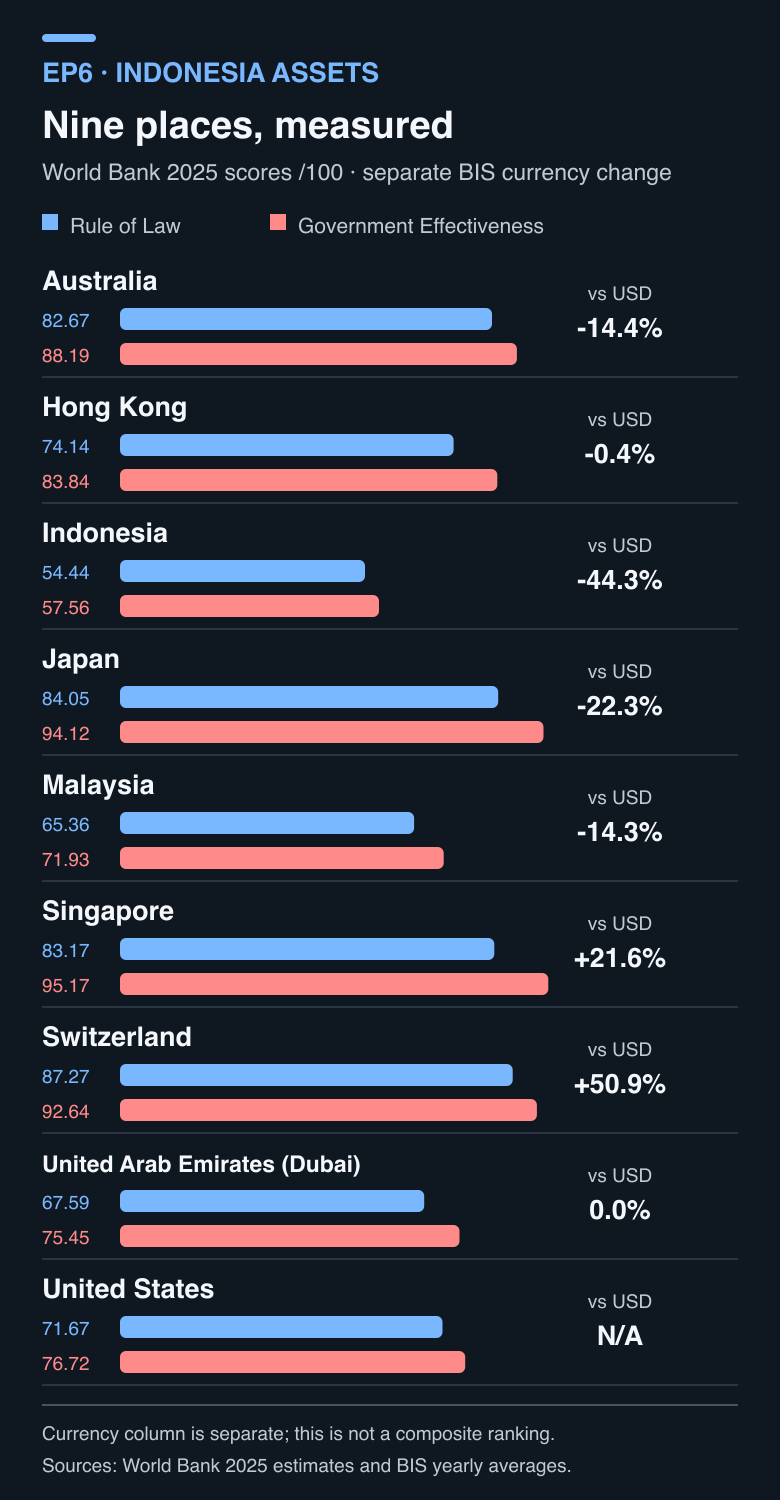
A comparison, not a ranking. This chart uses the same two governance measures and exchange-rate changes for nine places. Causes differ by country, and this table does not show costs, buyer rules or whether a family can open an account.
Nine-place comparison
- Australia: Rule of Law 82.67; Government Effectiveness 88.19; currency change vs USD -14.4%.
- Hong Kong: Rule of Law 74.14; Government Effectiveness 83.84; currency change vs USD -0.4%.
- Indonesia: Rule of Law 54.44; Government Effectiveness 57.56; currency change vs USD -44.3%.
- Japan: Rule of Law 84.05; Government Effectiveness 94.12; currency change vs USD -22.3%.
- Malaysia: Rule of Law 65.36; Government Effectiveness 71.93; currency change vs USD -14.3%.
- Singapore: Rule of Law 83.17; Government Effectiveness 95.17; currency change vs USD +21.6%.
- Switzerland: Rule of Law 87.27; Government Effectiveness 92.64; currency change vs USD +50.9%.
- United Arab Emirates (Dubai): Rule of Law 67.59; Government Effectiveness 75.45; currency change vs USD 0.0%.
- United States: Rule of Law 71.67; Government Effectiveness 76.72; currency change vs USD not available.
The first two columns are World Bank 2025 estimates on a 0 to 100 scale. The last column is the percentage change in yearly-average currency value against the US dollar from 2006 to 2025, calculated from BIS data. “Not available” means the chart's fixed currency-period comparison was not available, not that the United States has no currency data. This is not a composite score, causal test, ranking or recommendation.
Which way fits whom, and when is Singapore not the fit?
- Way 1, foreign money: Useful when some savings in another currency matter; an account abroad adds another country's rules, and any currency can fall.
- Way 2, regular income: Useful when payments matter; borrower default, dividend cuts and tax can reduce what arrives.
- Way 3, rent: Useful when property income fits; buyer rules, licences, taxes and slow resale depend on where the property sits.
- Way 4, precious things: Useful when holding value matters; there is no income while held, and custody failures can block access.
- Way 5, children: Useful for planning access and education; Indonesian tax duties continue, and residence permission is never automatic.
- Singapore home purchase: Apply a published foreigner, permanent-resident or listed trade-agreement rule only if it fits your status; the 60%, 5% and citizen treatments have different eligibility.
- Indonesian tax: None of these routes is shown to lower it; assets abroad do not remove Indonesian tax or reporting.
This list is not a ranking. Which way fits depends on your whole situation, and this article does not know yours.
Is any of this hiding money from Indonesia?
No, and nothing here depends on hiding anything. Indonesia exchanges bank account information with many places each year, under a global standard. Its tax office published its 2026 lists on 20 January 2026: 117 places send account information about Indonesian residents, and Indonesia sends to 92 (DJP, PENG-1/PJ/2026 list, read 28 October 2026). Singapore is on both lists, and so are Malaysia, Switzerland, Hong Kong, Japan and Australia. The United Arab Emirates, which includes Dubai, is listed as sending account information to Indonesia. The United States is on neither list; secondary reports say it uses its own system (FATCA).
For Indonesian resident individuals, the annual tax return (SPT) asks for assets held at home and abroad (DDTCNews, 5 June 2025). So the purpose stays lawful: spreading risk, and reporting what you own.
So what should Ibu Sari do now?
The gas story was about having another source, not predicting the next cut. So Ibu Sari does not start with an investment choice. Her first planning step is one list of what she owns: for each asset, its currency, its country, the rules that govern it, and how Rina and Bayu could legally receive it. That one list shows how many pipes she has, and where each asset sits.
The rest follows at its own pace. Way 1 can start small, and it includes foreign notes she holds herself, though cash at home still follows Indonesian rules. Way 5 can change her children's choices and access, but education and residence decisions take years. Having children already at university does not stop a family from starting this planning.
This is general information, not a forecast, and rules change; each source's read date is shown where it is used. Nothing here tells you where to put anything, and no single country is the answer. To read the sources or ask the property team about a Singapore property question, use cassia-fo.com.
About this article: Cassia Fo is an AI presenter, not a CEA-licensed salesperson. This is general information, not tax, legal, immigration or investment advice. The team linked from cassia-fo.com is a property team and handles property questions only. The person behind Cassia Fo is a PropNex-registered salesperson who works on the seller and landlord side; when you speak to any agent, including that team, ask who they act for in your transaction.
Notes and sources
The links beside each material claim are the primary reading path. These notes keep only the extra context used for the article's limits, not a second bibliography. Laws and official pages are quoted as read on the shown date and may later change.
- Gas and supply: CNBC Indonesia, Singapore ministry reply, SG101 energy, and SG101 Tampines.
- Indonesian policy examples: Cabinet Secretariat VAT notice, export-proceeds rule, Antara permits, and Kontan plantation case.
- Foreign money and income: Law 24/1999, BIS exchange series, Investor.gov bonds, FINRA bonds, IRAS dividends, and IRS Publication 515.
- Property and family access: Japan Tourism Agency, Japan Ministry of Finance leaflet, IRAS ABSD, SLA foreign ownership, Singapore Judiciary probate guide, Probate Act section 47, and IRAS estate duty.
- Reporting and comparison limits: DJP 2026 list, World Bank WGI, and DJP SPT reporting explanation.