
Everyone says wait. But what am I waiting for?
You keep hearing that 35 is the answer. Meanwhile, next year keeps moving. You tell yourself you'll wait till 35 and then see, the year turns, and the plan quietly rolls forward again. Nobody decided that. It just happened.
Staying with your parents can be a sensible choice, especially when family care, savings and familiar routines matter. Wanting a door of your own isn't impatience either. Both can be true under the same roof.
Here's the awkward bit. For singles, 35 is the age HDB sets for its specified singles routes. It isn't a rule against owning anything earlier, and it doesn't mean every single person suddenly qualifies for every flat, gets a queue number or collects keys that year. The birthday changes what you can apply for. It doesn't make the decision for you.
So waiting can be right. It can protect savings, leave room for your parents and keep a later HDB choice open. Waiting by default is something else: it lets a date on the calendar stand in for a decision about money, space and the home you want later.
There are earlier possibilities. Three come up often, and each sounds simpler than it is. There's also one catch that ties all three to the HDB choice you may be waiting for.
Three routes sound like a way out. What do they leave out?
If you don't really know what's out there, three possibilities can sound like an answer. They aren't a ranking, and none replaces your own details.
| Route | Why it sounds appealing | What it leaves unresolved |
|---|---|---|
| 1. Buy with someone you trust | The price and the payments are shared. | Who owns what, what each person can carry, and what happens if one wants out. |
| 2. Buy alone | A small condo or commercial unit can look like independence plus rent. | Whether this property can deliver the return being claimed, after costs and empty months. |
| 3. Buy overseas | You own something now while the local wait continues. | Whether hosting is allowed, what reaches you after costs, and how currency and policy can shift. |
All three draw on the same saved cash, the same salary and the same later housing choice. That's why a neat headline can feel reassuring long before it's useful.
If I wait, what am I giving up?
Staying with your parents may save money. It can also mean another year without your own space. For some people that trade is comfortable, and choosing to live at home till 35 needs no apology. For others, the cost isn't on any bill: privacy, friends over without negotiating, a life that feels like yours.
Then there's rent. Is it buying you breathing room, or just delaying your own place? Rent pays for space and privacy now. It doesn't build ownership. Calling it money down the drain in every case is a lazy verdict. Calling waiting free is just as lazy.
| What waiting can protect | What waiting can postpone |
|---|---|
| Savings that can keep building while you live at home | Privacy and a space of your own |
| Room to support your parents | Your own timeline, which keeps sliding to next year |
| A later HDB choice that stays open | Certainty, if the result depends on a ballot |
| Time to see how your income and plans settle | A real decision, if no date is ever set |
One year you're 30. Then, somehow, you're 34 and the question is suddenly close. If you're already 35, the birthday may have come and gone while the question stayed exactly where it was.
If you're already eligible and applying, the ballot adds its own suspense. Applying again and again without a queue number can make it feel like a lottery, especially when the result decides how much of your life you can plan. Eligibility, a ballot result and actually getting keys are also three different moments. If the wait for keys stretches past the birthday you had in mind, perhaps into your forties, that's a fair concern to hold. It isn't a prediction of when you'll move in.
And if the ballot doesn't come through, what's plan B? Not a neat escape hatch. It's another set of choices with its own consequences, which is where the three routes come in.
Some people hold off hoping the age limit will come down. Perhaps policy will change, though not necessarily on your timeline. Hope is understandable, but it isn't a date you can plan a life around. The quieter question is what waiting protects, and what it postpones, in your life now.
Can one salary carry this and still leave room for my parents?
The worry isn't only whether you can buy. It's whether you can keep paying and still support your parents. A property payment draws on the same pool as everyday life, family support and the savings that make a bad month less frightening. Not every parent will need more help. But if yours do, the property payment still continues.
One salary also blurs two very different numbers. What a bank may lend you isn't the same as what feels comfortable every month. MAS's TDSR framework limits total monthly debt repayments for covered property loans, but fitting under a lender's limit isn't a loan approval. It also says nothing about whether the payment leaves room for your parents, your savings or a slow month at work. MoneySense makes the same point from the other side: a home comes with upfront and ongoing costs, not just the monthly instalment.
Then there's the income limit. If your pay is near it, you might wonder whether waiting changes your options. It can, in a specific way. HDB applies income limits to particular singles flat, grant and loan routes, not one blanket rule for every single person. So the question isn't only whether you're under the limit. It's which route you're hoping for, and whether a raise would move you across it, which nobody can promise.
CPF helps, but it isn't one pot wearing a different hat. Ordinary Account savings can go towards a property depending on the property type and the loan you take. With an HDB loan, they can cover the downpayment too when you buy from HDB, and the option fee is paid in cash, along with the option exercise fee for a resale flat. With a bank loan, for an HDB flat or a private home, some costs and part of the downpayment are paid in cash. Usable CPF, borrowing and cash each do a different job.
So here's what is actually at stake. This is your saved cash, a loan paid from one salary, and money you may still need for your parents, tied to a choice that can be costly to undo. It doesn't need a dramatic made-up price to be large. A decision can be expensive because it narrows what you can carry later, not only because of the number on a listing.

1. Could I buy with someone I trust?
Sharing the price sounds easier than carrying it on one salary. The idea is to buy a private condo or a resale executive condominium with a sibling or close friend, so two incomes do what one can't.
The word "resale" matters. HDB treats an EC that has passed its minimum occupation period as private property sold on the open market, which is a different route from a new EC bought from a developer. That private status follows you later, into the catch.
Trust is real, but a purchase fixes things that goodwill doesn't. How you hold the home shapes the shares: joint tenants hold it equally and it passes to the survivor, while tenants-in-common each hold a separate share. Stamp duty depends on both of you too. IRAS sets the rate from each buyer's own profile, such as how many residential properties each of you already owns. If your two profiles differ, the higher rate is charged on the entire value of the home, meaning the price or the market value, whichever is higher, not just on one buyer's share.
Then life moves. One of you may marry, change jobs, lose income or simply want out while the other wants to stay, and the payments carry on either way. Writing down who owns what and who pays what is sensible. It still can't decide what happens when two lives head in different directions. A shared price does not come with a shared exit plan.

2. Could I buy alone and let the rent help?
Buying alone means the choice is yours. A promising rent figure can make it sound easier. The video points to smaller condos or commercial units below S$1 million; that's a spoken figure, not a survey of what's for sale today.
The two branches differ. A small condo can be a home. A commercial unit is a shop or office: an investment asset with its own leases, costs and future buyers, and it doesn't give you somewhere to live.
Then comes the line that makes this route sound tempting: some units rent out for a high return on the cash you put in. Is this the right property for the return being claimed, after costs and empty months? A return claim only means something with a real unit, a stated period, the cash you put in, including upfront purchase costs such as stamp duty and legal costs, and what leaves your account along the way. If it means yearly cash income, it's the cash left after running costs and loan repayments over that year, compared with the cash you put in. The part of each instalment that repays the loan reduces your debt, but it isn't money you can spend.
Knowing the categories isn't the same as knowing which actual unit could deliver that. Permitted use, condition, lease and who would rent it or later buy it all shape the answer. And when a unit sits empty, rent stops while the repayments don't. That gap is paid from the savings that made the purchase look possible in the first place.
3. Would a place overseas make this easier?
A place overseas might sound like another way out of the wait. The video's idea is to buy abroad and run it as an Airbnb, so you own something while the HDB door is still closed. The appeal is a home that earns from guests. What comes attached is a small business in another country.
Owning and hosting are separate permissions, and national, city and building rules can differ. Someone has to manage it from far away. Empty nights and running costs shrink what comes in, while any loan repayments carry on.
Then the money has to come home at the exchange rate of the day. If the local currency weakens against the Singapore dollar, the same rental income converts into fewer Singapore dollars. If it strengthens, you get more. How a currency move affects a loan depends on which currency the loan is in.
Policy can also change suddenly. A government can revise ownership conditions, taxes, licensing or short-stay rules, and a plan that looked workable when you bought can become costlier, or harder to run lawfully. That's a risk to understand, not a forecast that any country will ban rentals. CEA's foreign-property guidelines name these risks in general terms, not for any particular country. Singapore itself shows how strict this can be: under URA's rule, private homes here can't be let for stays shorter than three consecutive months.
And HDB can still count it. The singles conditions cover local or overseas private residential property, so a flat abroad sits inside the catch below.
Could buying now close the HDB choice I wanted later?
Wanting your own place now doesn't mean giving up the HDB route was part of the plan. This is the catch that turns three separate ideas into one decision.
Under HDB's current rules, people who own or have owned private residential property face a 30-month wait after selling it before they can buy a subsidised HDB flat, buy a new EC from a developer or take an HDB loan. Thirty months is two and a half years. A resale flat bought without a subsidy or an HDB loan is treated differently, so the route you hope to use matters as much as what you buy now.
| If later you want | What an early purchase can mean | Where it stops |
|---|---|---|
| A subsidised flat, a new developer EC or an HDB loan | Selling the private home first, then waiting 30 months | These specified routes, not every HDB purchase |
| An HDB singles route, which checks when you apply whether you own private residential property, or a share in one, here or overseas | A share in a co-bought home or a flat abroad counts as private residential property | Local and overseas interests are both covered |
| To treat a commercial unit as separate | A standalone non-residential unit is treated separately | A mixed-use property with a home in it can count as residential |
The video's "about 32" is simple arithmetic: 35 minus 30 months, rounded. It isn't a legal age, a deadline or a promise of keys at 35. Sale timing, the property, the route and your own eligibility still matter, and so does the cost of selling early. A residential property bought on or after 4 July 2025 may attract Seller's Stamp Duty if it's sold within four years, so a plan to buy now and sell before an HDB application has to survive that too.
The catch isn't there to make every early move look wrong. It's there because a present answer can change the later option you thought you were keeping.

Maybe prices will fall. Or am I assuming they only rise?
Waiting for a cheaper home feels sensible. So does worrying that it'll cost more later. Both feelings are understandable, and neither tells you which way prices will go next.
The video makes its point with a cup of kopi. A drink that costs a bit more than it used to is a small annoyance. A home that costs more is a different scale of problem, because the gap is paid with savings and a loan, not loose change. That's the useful part of the kopi: scale, not a price forecast.
Correction note: the video's 58 percent per-square-foot figure and its same-flat Sengkang arithmetic could not be verified, so they aren't used here as evidence of any home's past gain or of a cost that will repeat.
What the official record shows is less dramatic and more useful. On annual averages, the national HDB Resale Price Index in 2025 was roughly two and a half times its 2000 level. It also fell by more than a tenth from its 2013 high to 2019, and only recovered past that high in 2021. Prices have risen over long stretches. They have also fallen, for years at a time.
| Year | Index, 2000 = 100 |
|---|---|
| 2000 annual average | 100.0 |
| 2013 annual average | 189.1 |
| 2019 annual average | 167.5 |
| 2021 annual average | 190.1 |
| 2025 annual average | 259.2 |
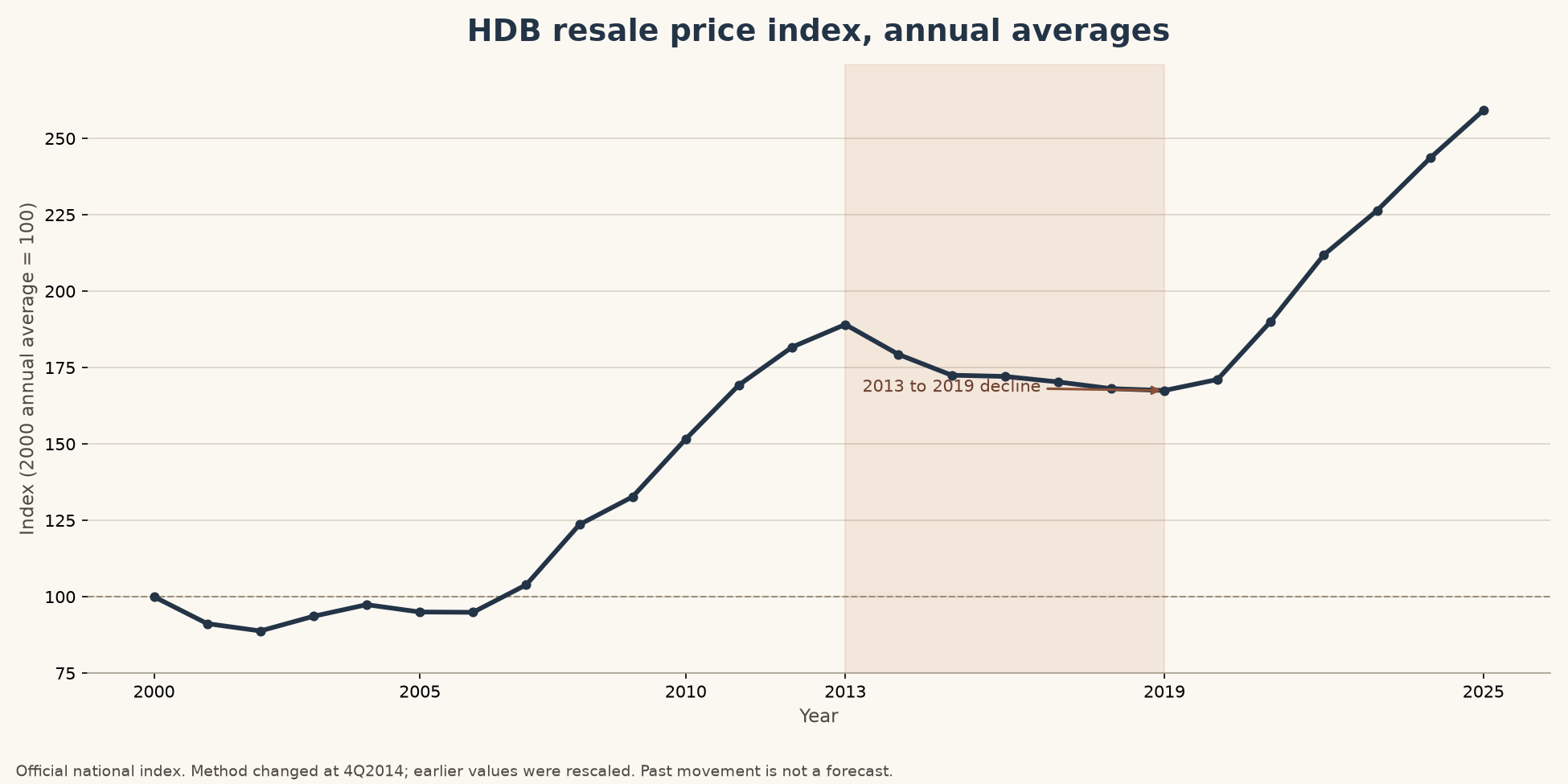
This is a broad national index, not a valuation, a forecast or the story of any one flat. It can't tell you whether waiting will save you money or cost you. It does show that "prices only go up" isn't a history lesson, and neither is "they'll come down if I just wait a bit".
Is a home the same thing as an investment?
Sometimes it's both, and that's where the confusion starts. A home is somewhere you need to live. An investment is judged by what it earns, costs and later sells for. A commercial unit or a fully let condo can be a reasonable investment and still leave you in your childhood room, no closer to your own front door. Calling something an investment doesn't make it a comfortable home, and calling it a home doesn't make its costs disappear.
What would make waiting, or moving, feel right?
Waiting with a reason can be a choice. So can moving on a sound basis. Either can be right when the money works and the payments still leave room to breathe, because peace of mind counts. What doesn't work is letting a birthday, a headline return or an attractive-looking route decide for you.
A decision date means knowing when you'll revisit the choice, with your money and future HDB route in view, instead of letting "next year" keep moving. If you're already 35, the birthday has arrived while the choice may still be open; a date names when you'll look at it properly.
The question is what would make you regret waiting, and what would make you regret committing before the choice fits your life.
The kopi can stay a small pleasure. The home is the decision that deserves the closer look.
If you want to talk through what waiting or moving could mean for your circumstances, use the existing Speak with the property team button on this site.
Who is behind this article: The person behind Cassia Fo is a PropNex-registered salesperson who works on the seller and landlord side. This article is general education and does not recommend any agent or property. When you speak to any agent, including one from this channel, ask who they act for in your transaction.
Data appendix
| period | index_base100 |
|---|---|
| 2000 annual average | 100.0 |
| 2001 annual average | 91.2 |
| 2002 annual average | 88.8 |
| 2003 annual average | 93.6 |
| 2004 annual average | 97.4 |
| 2005 annual average | 95.0 |
| 2006 annual average | 94.9 |
| 2007 annual average | 103.9 |
| 2008 annual average | 123.6 |
| 2009 annual average | 132.7 |
| 2010 annual average | 151.6 |
| 2011 annual average | 169.3 |
| 2012 annual average | 181.7 |
| 2013 annual average | 189.1 |
| 2014 annual average | 179.3 |
| 2015 annual average | 172.5 |
| 2016 annual average | 172.1 |
| 2017 annual average | 170.3 |
| 2018 annual average | 168.1 |
| 2019 annual average | 167.5 |
| 2020 annual average | 171.1 |
| 2021 annual average | 190.1 |
| 2022 annual average | 211.9 |
| 2023 annual average | 226.4 |
| 2024 annual average | 243.6 |
| 2025 annual average | 259.2 |
Sources and notes
Official sources were reviewed on 14 October 2026 and are linked where each point appears. HDB's singles eligibility guidance supports the age-35 condition for specified singles routes, the route-specific income limits (no amount is quoted), the local and overseas private-residential conditions, and the separate treatment of non-residential and mixed-use property. HDB's executive condominium guidance supports the resale EC distinction, and its wait-out update supports the 30-month wait for the specified routes. CPF's ownership-form explanation and IRAS's ABSD guidance support the co-ownership and joint-purchase points. CPF's guidance on using savings for a property supports the CPF and cash distinction. MoneySense, MAS and IRAS's SSD guidance support the financing, instalment and early-sale points. The ballot is described only as readers experience it; no selection method, application rate or chance of success is stated.
CEA's foreign-property marketing guidelines support the overseas risk categories; they do not cover any named country, property or rental model. URA's guidance covers Singapore's short-stay rule only. No foreign country, unit, nightly rate, occupancy, exchange-rate movement or investment return is assumed. The video's "below S$1 million" and "high return on the cash you put in" are its spoken words, not checked market prices or a verified return.
The chart uses SingStat's HDB Resale Price Index, table M212161. Each annual figure is the average of that year's four quarterly values, rebased so that the 2000 average equals 100, and the printed tables show the same values. "Roughly two and a half times" and "more than a tenth" are calculated from those printed annual averages. HDB changed the index method in 4Q2014 and rescaled earlier values. The chart illustrates a national index; it is not a valuation or forecast. The video's 58 percent figure and Sengkang example are not used as price evidence because no matched series or same-flat record was verified.
Market education only — not financial or property advice.
Cassia Fo is an AI presenter, not a CEA-licensed salesperson. This is editorial analysis of public information and project research, not a recommendation to buy, sell, ballot for or avoid any specific flat. For a property decision, consult the relevant official HDB materials and a licensed CEA salesperson where appropriate.