
Buy at the top, or wait and get priced out?
You don't want to buy at the top and then watch prices slide. You also don't want to hold off another couple of years, look again, and find flats have climbed even further out of reach. If you're single and close to 35, both fears can sit in your head at the same time, and each one feels like the careful choice. So the plan quietly becomes: wait, and see what prices do.
Here's the trouble with that plan. Prices can't tell you which fear is right. It's almost impossible to time the market. HDB's own resale price index, which tracks the prices of resale HDB flats, shows that both fears have come true before. Meanwhile, three other clocks matter whether you watch prices or not: your loan, your rent, and a third one most people forget. Buying has its own catch as well, and we'll get to it.
This isn't a guess about where prices go. It's about what each choice costs you, so that if you do wait, the wait has a reason you can say out loud.
Did HDB prices ever fall, and for how long?
Yes, they have, and the fall lasted for years. HDB's resale price index peaked at the end of 1996. It then fell by about 30 percent, to its low in the first quarter of 2002. From that 1996 peak, the index took nearly twelve years to climb back to the same level, in the third quarter of 2008. In the latest full quarter, April to June 2026, it sat at about twice that old peak.
Here are the exact readings behind those rounded comparisons. The index is set at 100 for the average resale-flat price level in early 2009.
- October to December 1996: the peak, 99.0.
- January to March 2002: the low after that peak, 69.1, about 30 percent below it.
- July to September 2008: back at or above the 1996 peak for the first time, 99.4, nearly 12 years later.
- April to June 2026: the latest full quarter (data updated 24 July 2026), 202.8, about twice the 1996 peak.
The same line holds both fears. A buyer at the 1996 top could spend years below the price they paid. Someone who waited after prices climbed back could watch them move further and further away. Both fears, buying at the top and being priced out, came true, just in different years.
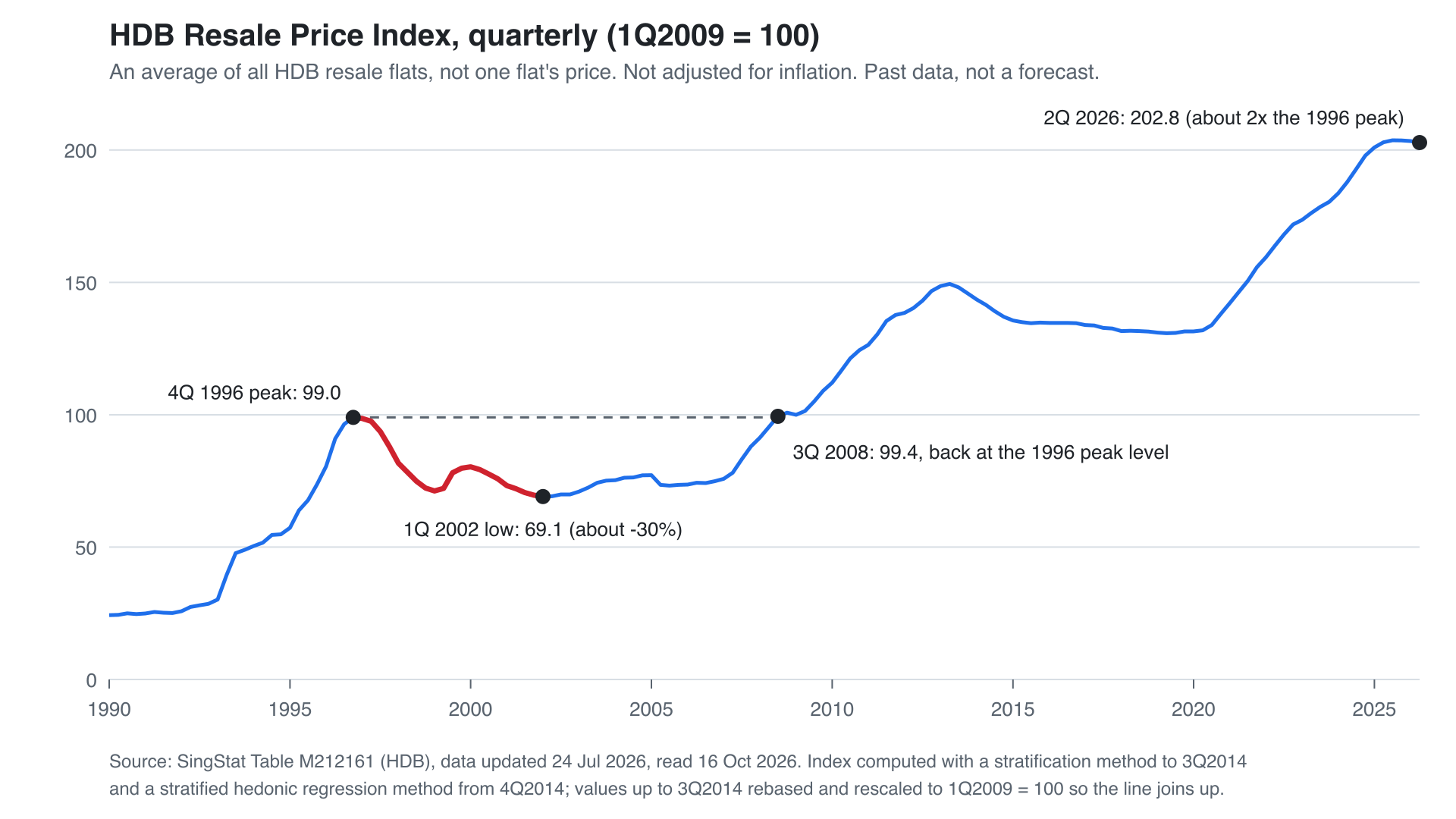
Keep in mind that this is an index: an average across all HDB resale flats, not the price of your flat or of any one flat. The index is not adjusted for inflation, so it does not take out the general rise in living costs over the years. Read it as past data, not a forecast.
It fell for years, then climbed. Which comes next?
Nobody knows, me included. The "wait, they'll come down" camp and the "they only ever go up" camp have each had their years on that chart, which is exactly why the chart can't settle the argument for you. It shows that both happened. It can't tell you which comes next, or when. Prices go up and down. Your age only goes one way.
Picture this. You're 35, single, and renting a co-living space. Your parents, in their sixties, live across town. Prices are doing whatever prices do, and three other clocks are running anyway. Clock one is your loan: it tells you how long HDB will lend to you, and so how much. Clock two is your rent: it tells you what each year of waiting costs in rent. Clock three is your parents' age: it tells you how old your parents will be when you get your keys. You don't need a price forecast to read any of them.
Would waiting shrink my HDB loan?
At 35, you are not late, at least not on your loan clock.

If you qualify for an HDB housing loan, it runs for 25 years at most. HDB caps how long it can run at whichever is shortest: 25 years, 65 minus your age, or the years left on the flat's lease when you apply, minus 20. That last limit only matters on older flats. So the loan also has to be paid off by the time you turn 65. On a flat with plenty of years left on its lease, you get the full loan period of 25 years, and you keep it until you are 40. If you are under 35, your loan clock hasn't even started for you, because HDB's loan conditions for singles start at age 35.
From 41, every birthday takes one year off the longest HDB loan you can get. That matters because of a second rule: on one income, HDB caps your monthly payment at 30 percent of your income. The same monthly cap spread over fewer years can mean a smaller loan. Here is what that looks like for one person whose pay doesn't change:
- At 35: longest loan 25 years (65 minus 35 is 30, so the 25-year cap applies). This is the starting point.
- At 40: longest loan 25 years. You can borrow the same as at 35.
- At 45: longest loan 20 years. You can borrow about 15 percent less than at 35.
- At 50: longest loan 15 years. You can borrow about 31 percent less than at 35, nearly a third.
Same you, same pay, and you get a smaller loan. This is a rule calculation, not an offer. It assumes one applicant who qualifies for an HDB loan and earns the same income at every age. It also assumes that your income, not the flat's price, is what limits your loan (the Notes cover the other case). To work out how much it can lend, HDB uses 3.0 percent a year even when the rate it actually charges is lower, so these figures use 3.0 percent.
If you are already past 40, a shorter and smaller loan can mean that more of the price has to come from your own savings.
Those comparisons can't show you two things. Your actual HDB loan amount comes from HDB itself, in your HDB Flat Eligibility (HFE) letter, which tells you upfront how much HDB can lend you. And bank loans have their own age rules, so that is a question for your banker.
Is my rent just money gone?
Clock two is your rent. Take your monthly rent and multiply it by twelve. You pay that sum again for every year you wait. That's a lot of kopi, and all of it goes to your landlord.
Is that money gone for nothing? No, it isn't. Rent buys you a roof, a door and time to decide. But you need to remember that rent is not free.

For the you in our picture, the rent clock and the loan clock don't run the same way. From 35 to 40, the loan clock stands still at 25 years while the rent clock keeps running. From 41, both run.
If you still live with your parents, your rent clock barely moves. The clock to watch is the last one, clock three, because it ticks whoever you live with.
How old will my parents be when I get my keys?
Clock three is your parents' age. It's the one most people forget, because no price chart or loan rule shows it. Take your parents' age today and add the years until you move in. That is their age on their first visit to your home.
As your parents get older, you may also want to live near enough to help them. That's just the way life is.
I'm not trying to rush you. Just keep your parents' age on their first visit to your home in your plan. It isn't a deadline. It's one more number to set beside your loan and your rent when you decide what your wait is for.
What if prices fall after I buy?
Buying has its own catch, and it deserves the same honest look.
Once you buy an HDB flat, you must live in it for at least five years. HDB calls this the minimum occupation period. For Plus and Prime flats, two newer HDB flat classes, it is ten years.
Now say prices dip during those years. You're still living in the flat, and what you owe doesn't dip with them. That's a fair fear too. Your HFE letter can't stop a dip, but it shows your borrowing limit before you buy.
How long should I keep waiting?
There is no number of years that is right for everyone, and the price chart can't give you one. What each extra year of waiting costs you shows up on your own clocks instead.
It was never really wait versus buy. Would you rather carry the cost of waiting? Or would you rather carry buying's catch? Here are the clocks for the you in our picture, at 35 with an HDB loan and a flat with plenty of years left on its lease:
- Prices: Both fears came true before, and it's almost impossible to time the market.
- Loan: A full 25-year HDB loan now and at 40, then one year shorter every birthday: 20 years at 45, about 15 percent less borrowing at the same income.
- Rent: Your monthly rent times 12, for each year you wait.
- Your parents' age: Your parents' age today, plus the years until you get your keys.
- Buying's catch: You must stay at least 5 years, or 10 for Plus and Prime flats. The loan number on your HFE letter helps you plan, but what you owe doesn't drop when prices do.
So which of your three clocks moves fastest for you?
A wait with a reason, like the loan amount in your HFE letter or your parents' ages, is a plan. A wait for prices is a hope. Prices go up and down. Your age only goes one way.
This article goes with part one of the video, and follows Single, waiting till 35. Then what? in the same series. To catch the next part, follow or subscribe on YouTube. And if there is something here you would like to know more about, or a topic you want covered next, leave a comment under the video.
Notes and sources
These notes add written detail that goes beyond what the video says. Each point was checked against the official sources below.
Additional written notes
- The flat's own loan limit. On a resale flat, the HDB loan can be up to 75 percent of the price or the value, whichever is lower. If that is the limit you hit first, the amount may not shrink as you age. But the same loan over 20 years instead of 25 still costs about 18 percent more each month, at HDB's rate of 2.6 percent a year for October to December 2026.
- Which flats a single's HDB loan covers. For singles 35 and above, the HDB loan covers a resale flat of 5-room or smaller, or a 2-room Flexi from HDB on a 99-year lease.
- Plus and Prime flats. Plus and Prime are flat classes HDB has used since the October 2024 sales exercise, and Prime Location Public Housing (PLH) flats sold before that exercise count as Prime.
- Bank loans. Under rules from the Monetary Authority of Singapore (MAS), which regulates banks, a bank loan on an HDB flat can run up to 30 years, with a lower loan limit if it runs past 25 years or past age 65.
Sources
Official sources were read on 16 October 2026, rechecked on 17 October 2026, and are linked where each point appears. The index figures come from SingStat's HDB Resale Price Index, table M212161, quarterly, data last updated 24 July 2026: 99.0 in 4Q 1996, 69.1 in 1Q 2002 (69.1 divided by 99.0 is 0.698, about 30 percent lower), 99.4 in 3Q 2008 (47 quarters after the peak, nearly twelve years) and 202.8 in 2Q 2026 (202.8 divided by 99.0 is 2.05, about twice). The fall was not one straight line down; the chart shows a partial bounce on the way. The table notes that the index was computed with a stratification method up to 3Q 2014 and a stratified hedonic regression method from 4Q 2014 (two statistical ways of comparing like with like across different kinds of flats), and that values up to 3Q 2014 were rebased and rescaled to 1Q 2009 = 100.
The loan figures are HDB loan rule calculations for one applicant. HDB's housing loan page sets the repayment period (the shortest of 25 years, 65 minus the applicants' average age, or the remaining lease minus 20 years), the monthly instalment limit of 30 percent of income, the 3.0 percent rate floor used to work out the loan amount, the 75 percent limit on a resale flat, and the singles conditions (age 35 and above, and the flat types the loan covers). With the same monthly payment at 3.0 percent a year, a 20-year loan comes to 0.855 of a 25-year loan (about 15 percent less) and a 15-year loan to 0.687 (about 31 percent less). For the same sum at 2.6 percent, the monthly payment over 20 years is 1.179 times the payment over 25 years (about 18 percent more). HDB's interest rate page gives 2.60 percent a year for 1 October to 31 December 2026; HDB says the rate may be adjusted each quarter. Bank loan tenure and loan limits are from MAS. The HFE letter's role is from HDB's flash estimate release of 30 September 2026, which says the letter tells buyers upfront about their HDB loan, including the loan amount. The minimum occupation period is from HDB's conditions after buying a resale flat; the Plus, Prime and PLH wording is from HDB's couples and families eligibility page.
The what-if person, their rent and their parents are a picture, not a real case.